
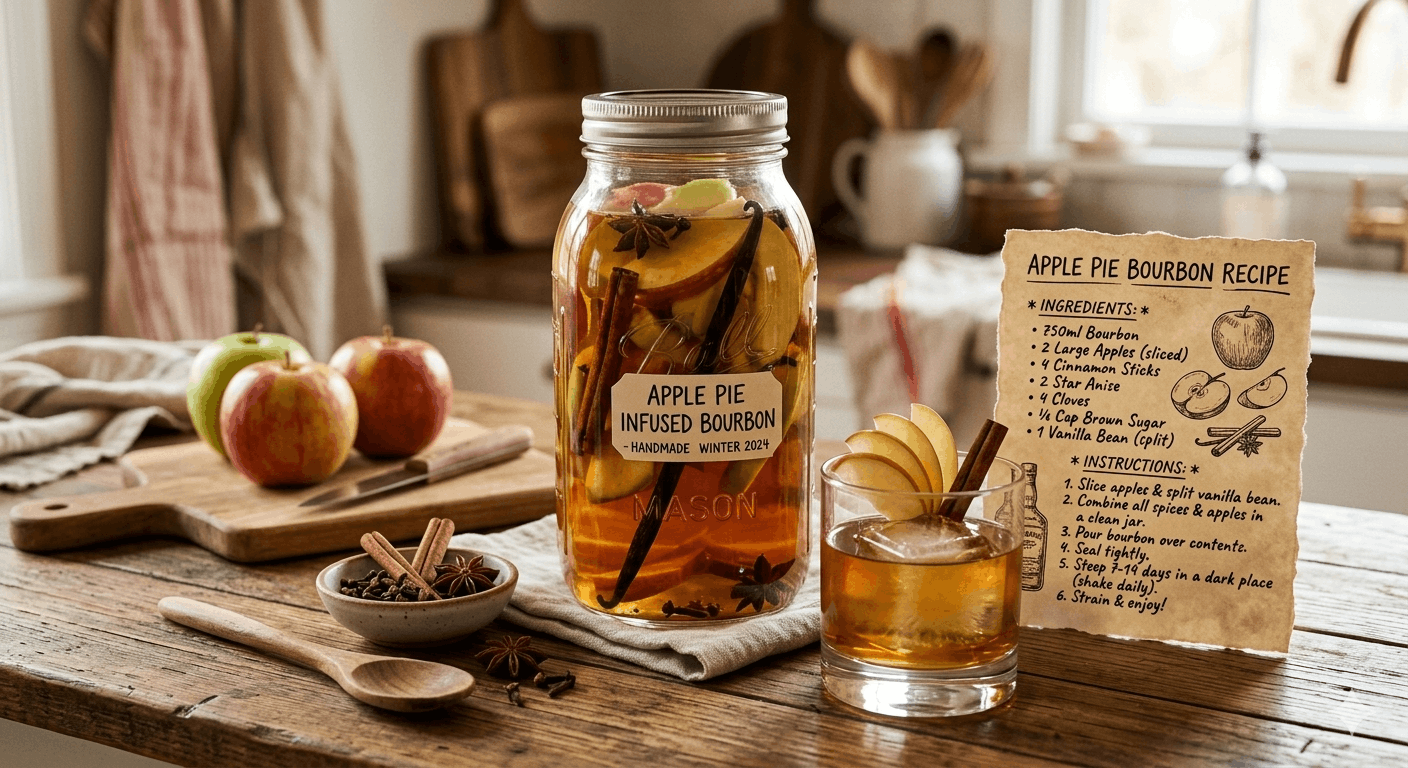

Apple Pie Infused Bourbon
Ingredients
Equipment
Method
- Step 1 — Prepare the applesWash the apples thoroughly under cold water and dry them completely. Core each apple and slice into wedges roughly ¼ to ½ inch thick — you want enough surface area exposed to the bourbon to allow efficient flavor transfer, but not so thin that the apple breaks down into mush before the infusion is complete. Leave the skin on every slice: the skin contains pectin, tannins, and volatile flavor compounds that contribute meaningfully to the final flavor profile. You may notice some browning on the apple flesh during the infusion — this is normal and does not affect flavor. Split the vanilla bean lengthwise with a sharp knife, scrape the seeds from both halves into the jar using the flat of the blade, and drop the pod in as well.
- Step 2 — Load the jarPlace the apple slices, cinnamon stick, vanilla bean (seeds and pod), and any optional spices directly into your clean glass mason jar. Pour the entire 750ml bottle of bourbon over the contents — the bourbon should cover everything completely. If some apple slices float to the surface, this is fine; they will release flavor regardless and will be strained out at the end. Seal the jar tightly and give it a gentle shake to distribute the ingredients. Label the jar with the date you started it so you can track the infusion time accurately.
- Step 3 — Store and agitate during infusionPlace the sealed jar in a cool, dark location — a cupboard, pantry shelf, or the back of a cabinet all work perfectly. Avoid direct sunlight, which can degrade the flavor compounds in the bourbon over a long infusion period. Shake or stir the jar gently every two to three days to encourage even flavor distribution. Beginning around day 3 to 5, open the jar and taste the bourbon: the cinnamon will be immediately assertive and the alcohol edge will already be softening. At this stage it tastes promising but not yet complete. Around day 7 to 10, the apple flavor becomes more apparent and the cinnamon begins to integrate. At the 2-week mark, most people notice a genuine balance emerging. The optimal window for most palates is 3 to 4 weeks — at this point the cinnamon has mellowed, the vanilla has fully developed, and the apple flavor reads as deep and settled rather than sharp and raw. Taste it every few days from week 2 onward and strain when it reaches the profile you want.
- Step 4 — Monitor and manage cinnamon intensityCinnamon is the fastest-moving flavor in this infusion and can, in a long infusion, tip the balance toward a Hot Tamales-style cinnamon burn rather than a nuanced apple pie. If you are tasting daily from week 2 and the cinnamon feels dominant, remove only the cinnamon stick with tongs and allow the apple and vanilla to continue developing without it. This gives you precise control over the final flavor profile — more cinnamon-forward results from leaving the stick in for the full period; a softer, more apple-and-vanilla-forward result comes from removing it at 2 weeks.
- Step 5 — Triple-filter for a clear, gift-quality result. When the bourbon has reached your desired flavor, it is time to strain. Set your fine-mesh sieve over a large bowl and pour the entire contents through it, pressing the apple slices gently with a spoon to extract all the infused liquid — these apple slices are thoroughly flavored and will yield significant liquid if pressed. Discard the spent solids (or save the apple slices to bake into a pie — they are deeply flavored and work beautifully as pie filling). Line the sieve with two layers of cheesecloth and pour the strained bourbon through a second time. Finally, set a paper coffee filter inside the sieve and pour the bourbon through in small batches — this step is slow (the filter takes time) but produces a crystal-clear, completely particle-free liquid. Be patient and do not press the filter, which can force fine particles through.
- Step 6 — Rest, bottle, and store. Transfer the filtered infusion into your clean bottle using the funnel, seal tightly, and allow it to rest at room temperature or in the refrigerator for at least 3 to 5 additional days before serving or gifting. During this post-filtration rest period, the flavors continue to integrate and mellow significantly — many people report that the bourbon tastes noticeably better one week after straining than immediately after. This is the final, invisible step that transforms a good infusion into a great one. Store in a cool, dark place indefinitely — the alcohol content preserves the infusion and no refrigeration is required once strained.
Video
Notes
- Bourbon selection is your most important decision: The infusion will amplify and complement whatever is already in the bourbon, not mask it. A harsh, low-quality bourbon will produce a harsh, low-quality infusion. A mid-shelf bourbon with good vanilla and caramel notes — Jim Beam White, Evan Williams Black Label, Bulleit, or Buffalo Trace — will produce a genuinely excellent result. Maker’s Mark or Woodford Reserve will produce something exceptional. Do not use flavored bourbon, which will conflict with the apple and spice profile.
- Granny Smith is the gold standard for good reason: Its tartness provides essential acidity that prevents the infusion from tasting flat or one-dimensionally sweet. Sweeter apple varieties (Fuji, Gala, Honeycrisp) produce a pleasant but less complex result. For the most nuanced, true-to-apple-pie character, use Granny Smith or a 2:1 blend of Granny Smith and Honeycrisp.
- How to know when it’s ready: Taste from the jar every 2–3 days beginning at the 1-week mark. The infusion is ready when: the harsh alcohol edge has softened noticeably, the cinnamon reads as warm and spiced rather than sharp, the apple flavor is present and deep rather than raw and acidic, and the vanilla provides a round, pastry-like finish. If you can close your eyes and think of apple pie, it’s ready.
- Most common mistake — not filtering thoroughly enough: A cloudy, particle-laden infusion will continue to develop off-flavors as the fine particles oxidize in the bottle. The triple-filtration method (sieve → cheesecloth → coffee filter) is non-negotiable for a shelf-stable, beautiful-looking product. Each filtration layer removes finer particles successively; skipping the coffee filter step leaves visible cloudiness that settles to the bottom over time.
- Variation — Apple Pie Old Fashioned Infusion: Add 4–5 allspice berries, 3 cloves, and ¼ tsp freshly grated nutmeg to the base recipe. The result is a mulling-spice version of the infusion that tastes more specifically of spiced cider than straight apple pie — excellent served warm in a mug with a cinnamon stick garnish.
- Variation — Brown Sugar Apple Bourbon: After straining, add 1 tablespoon of homemade brown sugar simple syrup (equal parts brown sugar and water, simmered until dissolved and cooled) per 750ml of finished infusion. This creates a lightly sweetened liqueur-style version that is softer and more approachable for non-whiskey drinkers. Start conservative and add more syrup to taste.
- Variation — Caramel Apple Bourbon: Add 2 tablespoons of high-quality caramel sauce (store-bought or homemade) to the straining bowl before the final filtration pour-through. Stir to combine, then filter as normal. The result has a confection-like richness that pairs particularly well with cream or ginger ale.
- Make-ahead for gifts: This infusion was practically invented for gifting. Start it 5–6 weeks before you need it, giving 4 weeks of infusion time and 1–2 weeks of post-filtration rest. Decant into clean 375ml or 750ml bottles, apply a handwritten label with the infusion date and serving suggestions, seal with a cork or swing-top, and tie a cinnamon stick to the neck with twine for presentation. A single 750ml batch can fill two 375ml gift bottles.
- What to do with the infused apples: Do not discard them. After straining, the apple slices are deeply bourbon-infused and make an extraordinary pie filling. Simmer them briefly with a tablespoon of brown sugar and a pinch of cinnamon, pour into a pre-baked pie shell, and you have a bourbon apple pie that tastes like nothing else. They can also be chopped and folded into oatmeal, crumble topping, or vanilla ice cream.
- Storage: Store the strained, bottled infusion in a cool, dark place — a liquor cabinet, pantry shelf, or cellar. No refrigeration required. The alcohol content fully preserves the infusion. Unlike fresh-fruit infusions, this one does not degrade over time; if anything, it continues to smooth and improve for several weeks after straining. Properly stored, it keeps indefinitely — though it rarely lasts that long.
- Quick-infusion (7–10 day) tips: If you need the infusion ready in under 2 weeks, increase the surface area of the apples (slice thinner, roughly ⅛ inch), add a small handful of dried apple rings alongside the fresh apples (dried fruit infuses significantly faster than fresh), and taste daily from day 5. The result will be somewhat less complex than the month-long version but very good — entirely acceptable for an impromptu holiday gathering or a last-minute gift.
- Scaling note: This recipe scales linearly and perfectly. For a 1.75L handle of bourbon, triple the apple quantity (8–9 apples), use 2 cinnamon sticks, and 1 full vanilla bean. The infusion timeline remains the same. For a test batch using half a bottle, halve all ingredient quantities. The jar simply needs to hold the bourbon volume and keep everything submerged.
WHAT IS Apple Pie Infused Bourbon?
The Concept in Plain Terms
Apple Pie Infused Bourbon is a cold infusion — meaning no heat is applied at any stage — in which fresh apples, cinnamon, and vanilla are steeped directly in bourbon for an extended period, typically two to four weeks, before being filtered out. The bourbon slowly extracts flavor compounds from everything it is in contact with: the sweet-tart apple flesh and skin, the volatile essential oils in the cinnamon stick, and the complex aromatic aldehydes in the vanilla bean. What remains after straining is a spirit that still carries the full proof and body of the original bourbon, but now has a layered second flavor profile built on top of it — one that any taster will immediately identify as apple pie.
This is not a cocktail. It is not a flavored spirit blended at a factory with artificial flavor extracts. It is a genuinely handcrafted product, made by the same process that craft distillers use to produce barrel-aged specialty spirits, just applied at home-kitchen scale and in a much shorter time frame. Every bottle is slightly different depending on the bourbon chosen, the apple variety, the length of infusion, and the moment the maker decides it has reached the right flavor, which is part of what makes homemade infusions compelling and personal in a way that commercial products can never replicate.
How Infusion Works
When raw botanical ingredients are submerged in a high-proof alcohol like bourbon, the ethanol acts as a solvent — far more effective than water at extracting flavor compounds from plant matter. Ethanol is particularly good at capturing the terpenes and phenols responsible for spice aromas (cinnamon, clove, vanilla), the esters that create fruit flavors (apple, pear, cherry), and the pigments that give many botanicals their color. The process is passive: the longer the ingredients remain in contact with the spirit, the more complete the extraction. Temperature, surface area, alcohol proof, and botanical freshness all influence the speed and character of extraction — which is why slicing apples (more surface area), using a good-quality bourbon (better base character), and waiting patiently (more complete extraction) all matter to the final result.
Why Bourbon Specifically
Bourbon is defined by law as a whiskey distilled from a grain mixture of at least 51% corn, aged in new charred oak barrels, and produced in the United States. The corn gives it a naturally sweeter, rounder base than scotch or Irish whiskey, and the charred oak aging imparts vanilla, caramel, toasted wood, and toffee notes that are already halfway toward dessert territory before a single apple slice enters the picture. Cinnamon, apple, and vanilla — the defining flavor notes of apple pie filling — map directly onto bourbon’s existing flavor architecture. No other base spirit produces quite the same result: vodka gives a cleaner, simpler apple-and-spice profile; rye whiskey adds a peppery note that can compete with the cinnamon; scotch brings smokiness that conflicts with the pie notes. Bourbon is the uniquely correct choice because what is already in it and what you are adding to it belong to the same flavor family.
The History of Infused Spirits
The practice of infusing spirits with fruits, spices, and botanicals predates distillation itself — fermented fruit macerations were a staple of medieval European home production, and the first commercial liqueurs were essentially pharmaceutical preparations of herbs in alcohol. In American domestic tradition, fruit infusions in whiskey or rum were a staple of rural home production throughout the 18th and 19th centuries, when distilled spirits were often rough and benefited from the softening influence of fruits and sweeteners. The apple pie bourbon infusion in its modern form — using Granny Smith apples, cinnamon, and vanilla in a mid-shelf bourbon — emerged as a popular home bartending project in the early 2010s, popularized by food bloggers and accelerated by the broader craft cocktail movement that placed renewed value on hand-crafted, seasonal, ingredient-driven drinks.
NUTRITION
Calories: Approximately 100–110 kcal per 1.5 oz (44ml) serving
| Nutrient | Per 1.5 oz Serving |
|---|---|
| Protein | 0g |
| Total Fat | 0g |
| Carbohydrates | 0–1g |
| Sugar | 0–1g |
| Sodium | 0mg |
| Alcohol | ~15g (ABV approximately 40%) |
Values are approximate. The infusion process does not significantly alter the caloric or macronutrient content of the base bourbon. Trace natural sugars from the apple and vanilla may be present in the final product.
BENEFITS
1. The Infusion Process Transforms a Mid-Shelf Spirit Into Something That Tastes Premium
A $20–$25 bottle of Evan Williams or Jim Beam, infused with quality fresh apples and a good vanilla bean for four weeks, produces a spirit that most tasters would guess costs significantly more — and that compares favorably with commercial apple-flavored bourbons that retail for $30–$45. The infusion softens the harsh alcohol edge, rounds the flavor with fruit and spice complexity, and adds a depth that no amount of artificial flavoring can replicate. This is one of the most dramatic quality-to-cost transformations available to a home bartender.
2. It Is One of the Most Universally Appealing Flavors in Existence
Apple pie is, in the most literal cultural sense of the phrase, as American as it gets. It triggers nostalgia, warmth, and celebration associations for virtually every person who encounters it. An infusion built around these flavors has a broader appeal ceiling than almost any other flavored spirit — it is immediately recognizable and desirable to bourbon lovers, to people who don’t normally drink whiskey, to holiday guests of widely varying taste preferences, and to anyone who simply likes the smell of a warm kitchen in autumn. It is, in the best possible way, impossible not to like.
3. It Is a Genuinely Meaningful, Personalized Gift
In an era of generic gift cards and mass-produced spirits, a bottle of handmade Apple Pie Bourbon — labeled by hand, infused with locally sourced apples if you want, and made specifically for the person receiving it — communicates effort, care, and personalization that no purchase can replicate. The production time (2–4 weeks of hands-off infusing) paradoxically signals more investment than an expensive bought gift: time is a more finite resource than money, and everyone knows it. A bottle with a handwritten label, a cinnamon stick tied to the neck with twine, and a card that tells the recipient how long it was infused is among the most thoughtful small gifts one adult can give another.
4. You Control Every Ingredient — No Artificial Flavors or Preservatives
Commercial apple-flavored bourbons and apple pie moonshine products invariably contain propylene glycol (a synthetic solvent used to carry artificial flavors), caramel color, and artificial apple flavor derived from chemical synthesis rather than real fruit. This homemade version contains bourbon, fresh apples, cinnamon, and vanilla — the complete ingredients list. For people who pay attention to what goes into what they consume, the difference is not trivial: this is a whole-food, additive-free flavored spirit that does not require qualification or explanation.
5. The Infused Apples Are a Bonus Zero-Waste Byproduct
After straining, the bourbon-soaked apple slices are deeply flavored with apple-cinnamon-vanilla-bourbon and are fully usable as the filling for an apple pie that has no equal. The fruit’s natural pectin holds them together through baking; the bourbon they have absorbed does not evaporate entirely during the short bake, adding a genuine boozy depth to the pie. This zero-waste aspect of the recipe — nothing is discarded that doesn’t need to be — makes it particularly satisfying from an ingredient-efficiency standpoint.
6. It Teaches Transferable Skills for a Lifetime of Homemade Infusions
Mastering this infusion — understanding how to taste for balance, when to intervene (removing a cinnamon stick before it dominates), how to filter for clarity, and how much post-filtration resting time improves the final product — builds a set of skills that transfers directly to every other spirit infusion: cherry bourbon, vanilla vodka, limoncello, coffee rum, habanero tequila, or any other combination. Apple Pie Bourbon is the ideal first infusion project because the flavor profile is recognizable, the margin for error is wide, and the results are reliably excellent — making it a perfect gateway into a deeply rewarding and inexpensive hobby.
BEST COMBINATIONS
Serving the Infusion Neat and On the Rocks
The simplest and most revealing way to serve Apple Pie Bourbon is on a large ice sphere or a single large cube, in a wide-mouthed whiskey glass, with no other additions. The slow dilution from the ice opens up the aroma gradually and rounds the higher proof notes without diluting the flavor too aggressively. Neat — no ice, room temperature in a small Glencairn glass — is the best way to evaluate the infusion as a craft product, where every note from tart apple to warm cinnamon to vanilla finish can be tasted in sequence.
Cocktails That Use It as the Base Spirit
- Apple Pie Old Fashioned: The most natural cocktail application. Build it in a rocks glass: 2 oz Apple Pie Bourbon, ½ tsp demerara simple syrup (or a sugar cube muddled with 2 dashes of Angostura bitters), a large ice cube, orange twist. Stir with ice until well-chilled. The bitters, orange, and syrup amplify the existing spice and fruit notes in the infusion without competing. This is arguably a better Old Fashioned than most made with standard bourbon.
- Apple Pie Manhattan: 2 oz Apple Pie Bourbon, 1 oz sweet vermouth (Carpano Antica if available), 1 dash Angostura bitters, stir with ice and strain into a chilled coupe. Garnish with a maraschino cherry or a thin slice of fresh apple. The vermouth adds dried fruit and herbal complexity; the result is sophisticated and autumnal.
- Bourbon Apple Smash: Muddle 4–5 fresh mint leaves and 3 apple slices with a bar spoon of simple syrup in a shaker. Add 2 oz Apple Pie Bourbon and ice, shake vigorously, and double-strain over crushed ice in a rocks glass. Garnish with a mint sprig and an apple fan. Bright, refreshing, and the most approachable cocktail format for guests unfamiliar with bourbon.
- Apple Pie Mule: 2 oz Apple Pie Bourbon, juice of half a lime, top with 4 oz ginger beer over ice in a copper mug. The ginger amplifies the cinnamon notes in the infusion and makes a dramatically spiced, warming drink. Add a dash of Angostura and a dehydrated apple slice for a seasonal presentation.
- Apple Pie Sour: 2 oz Apple Pie Bourbon, ¾ oz fresh lemon juice, ½ oz simple syrup, 1 egg white (optional, for froth). Dry shake all ingredients without ice for 15 seconds, then add ice and shake hard for another 15 seconds. Strain into a coupe. The egg white froth and lemon acidity make a tart, creamy cocktail that contrasts beautifully with the warm spice of the infusion.
- Apple Pie Sparkling Cocktail: 1.5 oz Apple Pie Bourbon, ½ oz apple juice, 3–4 oz dry sparkling wine (Prosecco or Cava). Build in a Champagne flute with ice, stir once gently, and garnish with a cinnamon stick. Festive, low-effort, and ideal for holiday parties where individual cocktail service is impractical.
- Warm Apple Pie Toddy: 1.5 oz Apple Pie Bourbon in a heatproof mug, top with 5 oz hot water or hot apple cider, add a teaspoon of honey, a squeeze of lemon, and float a cinnamon stick. This is a winter drink of exceptional comfort — the heat opens up the aroma of the infusion and makes the apple and vanilla notes bloom in a way that cold service cannot replicate.
Food Pairings
- Vanilla ice cream: A small pour of Apple Pie Bourbon over a scoop of good vanilla bean ice cream is one of the simplest and most extraordinary dessert presentations imaginable. The spirit’s chill from the bottle and the heat of the flavor against the cold cream is an experience that needs no further explanation.
- Aged cheddar or sharp cheese: The acidity and apple notes in the infusion make it a natural companion for aged cheddar, particularly a 2-year Vermont cheddar or a good English farmhouse. The combination mirrors the apple-and-cheddar pie pairing that is a legitimate tradition in parts of New England and northern England.
- Caramel apple desserts: Caramel apple tart, caramel apple cheesecake, or any caramel-apple dessert format has an obvious kinship with the infusion. Serve a small glass alongside the dessert rather than after it.
- Pecan pie: The caramel, nut, and vanilla notes of pecan pie and the warm spice profile of the infusion are one of the great autumnal pairings. Serve 1 oz neat alongside a warm slice.
- Dark chocolate: High-percentage dark chocolate (70%+) and the infusion create a sophisticated pairing in which the bourbon’s caramel notes bridge the chocolate’s bitterness, and the apple’s fruit acidity adds a brightness that makes the chocolate taste more complex.
Seasonal and Occasion Contexts
- Thanksgiving: The definitive occasion for this infusion. Apple, cinnamon, and vanilla are the three most prevalent flavors in the Thanksgiving dessert spread, and a small pour of Apple Pie Bourbon before or after dinner is a seasonal gesture that requires no explanation to any guest.
- Christmas gifts: Five to six weeks of production time, scaled to a 1.75L batch, yields four or five 375ml gift bottles — enough for the core of an entire holiday gift list, produced at roughly $6–$8 per bottle in ingredients.
- Autumn bonfire or harvest gathering: Served warm as a hot toddy or cold over ice, Apple Pie Bourbon is the single drink most likely to be universally enjoyed at an outdoor autumn event.
- Fall cocktail party: Batching the Apple Pie Mule or a Sparkling Apple Pie Punch (infusion + apple cider + ginger beer + Prosecco in a punch bowl) provides a seasonal, photogenic, crowd-pleasing centerpiece drink that most guests will ask about by name.
- After dinner during the holidays: Served neat or on ice as a digestif, a 1–1.5 oz pour of Apple Pie Bourbon at the end of a holiday dinner is a more interesting and personal offering than standard after-dinner spirits, and far more likely to generate conversation.
FAQs
No. The alcohol content of bourbon — typically 40% ABV or higher — is a complete preservative that prevents any bacterial or mold growth, even with fresh fruit submerged for a month or more. Store the sealed jar in a cool, dark cupboard. Refrigeration is not harmful but will slow the infusion slightly, as cold temperatures reduce the rate at which flavor compounds migrate out of botanical ingredients into the spirit.
Cloudy infusion after a first-pass straining is expected — apple pectin and fine spice particles remain suspended in the liquid after a coarse strainer pass. The solution is to filter again: pass the bourbon through cheesecloth once, then through a paper coffee filter for the final pass. Coffee filter filtration is slow — it can take 30–60 minutes for a full 750ml — but the result is completely clear. Pour in small batches and do not squeeze or press the filter, which forces particles through. If cloudiness persists after coffee filtering, simply allow the bottle to sit undisturbed for a week — particles will gradually settle to the bottom and can be poured out.
Remove the cinnamon stick immediately with tongs and allow the infusion to continue with the apples and vanilla only. The cinnamon will not retroactively fade from what is already in the bourbon, but without the stick continuing to release more cinnamon compounds, the overall balance will shift as the apple and vanilla flavors continue to develop. After straining and a further week of rest, most overly cinnamony infusions mellow significantly. As a preventive measure on the next batch, use one cinnamon stick instead of two, or remove it at the 10-day mark regardless of how it tastes at that point.
Yes, but you should understand what you are getting: after 2–5 days, the cinnamon dominates, and the apple flavor is still raw and alcoholic rather than settled and integrated. The vanilla will barely have started to express itself. A 5-day infusion is drinkable and genuinely pleasant as a cinnamon-forward whiskey, but it does not achieve the full apple pie character that requires a longer timeline. If you need it in under 2 weeks, increase the surface area of the apples (slice very thin), add dried apple rings alongside the fresh ones, and taste daily from day 3.
Yes — rye whiskey produces a spicier, more peppery result that some people prefer for cocktails like a Manhattan or a Sour; the peppery rye notes add a complexity that works well against the apple’s sweetness. Irish whiskey produces a lighter, more delicate infusion that is lovely served chilled neat. Tennessee whiskey (Jack Daniel’s, George Dickel) uses a charcoal mellowing step called the Lincoln County Process that produces a slightly softer, less barrel-forward profile — the infusion works well but tastes different from a traditional bourbon-based version. Vodka produces the most fruit-forward, spirit-neutral result — the apple, cinnamon, and vanilla are the primary flavors with no competing whiskey character, making it the most broadly accessible option but the least complex.
Indefinitely, if properly stored in a sealed bottle in a cool, dark location. The alcohol content prevents degradation. Unlike fresh-fruit infusions that are strained and then exposed to oxygen repeatedly through pouring, a properly bottled bourbon infusion with a tight seal will taste as good in three years as it does the week after straining — and may actually improve over that time, as the flavors continue to integrate in the bottle. There is no expiration date.
Yes, and many people do. The most elegant method is a simple syrup made from demerara or brown sugar (it has better flavor complexity than white sugar for this application): combine equal weights of sugar and water, heat until dissolved, cool, and add 2–4 tablespoons per 750ml of finished infusion to taste. Start with 2 tablespoons, taste, and add more incrementally. The resulting product is sweeter, more approachable for non-whiskey drinkers, and works very well served over ice cream or in dessert cocktails. Too much simple syrup makes the result sticky and one-dimensional — less is better.
Jim Beam White Label or Evan Williams Black Label are the two most recommended starting points: both are widely available, inexpensive, and have natural vanilla-caramel notes that infuse beautifully with apple and spice. Both have been used successfully by countless home infusers, including by the original recipe developer. If you want to step up for a gift batch, Bulleit Bourbon or Buffalo Trace — available in most liquor stores for $25–$30 — produce noticeably more complex results and are excellent choices for anyone you want to genuinely impress.
Completely safe. Apple flesh browning in the presence of oxygen is caused by enzymatic oxidation — the same process that makes a cut apple turn brown on a cutting board. In a high-alcohol environment, this process produces some color change but no off-flavors and absolutely no safety concern. The brownish apple slices at the end of a month-long infusion are deeply flavored and safe to use in baking. The bourbon itself may take on a slightly deeper amber color from the tannins in the apple skin — this is desirable and indicates good extraction.