
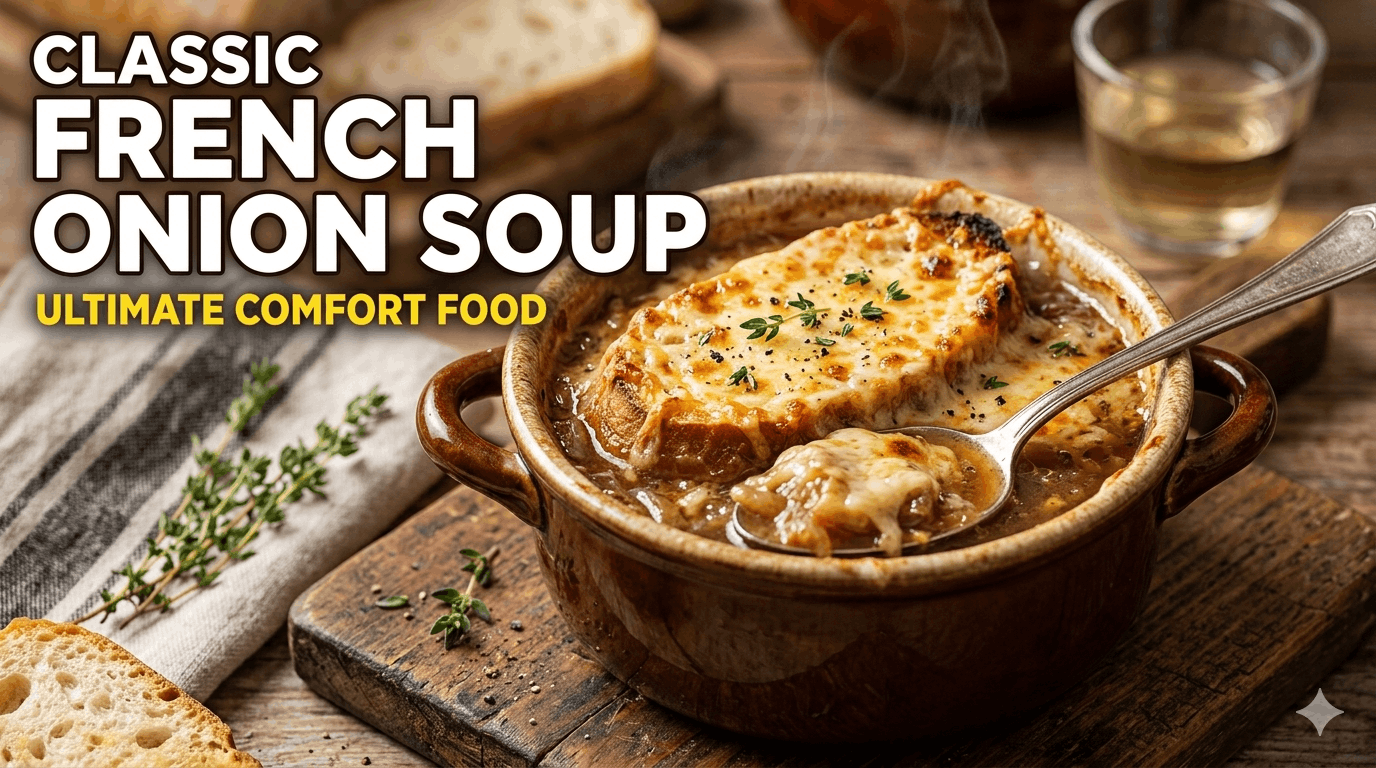

Classic French Onion Soup
Ingredients
Equipment
Method
- Step 1 — Prepare and add the onionsPlace your Dutch oven over medium heat. Add the butter and olive oil together and let the butter melt fully. Add all the sliced onions, salt, pepper, and sugar. Stir well to coat every onion strand in the butter mixture. The pot will look overwhelmingly full — this is normal. Onions lose around 75 percent of their volume as they cook. Do not cover the pot.
- Step 2 — Caramelize low and slow — do not rush thisCook the onions over medium to medium-low heat, stirring every 5–10 minutes for the first 30 minutes, then every 2–3 minutes for the final 15–20 minutes as they darken. The total time is 45–60 minutes. You are looking for a deep, rich, chestnut-brown color throughout — not pale gold, not light amber. Truly caramelized onions are jammy, collapsing, and deeply sweet-smelling. If at any point the onions begin to stick or catch on the bottom of the pot, add a splash of wine or water and use your wooden spoon to scrape up those browned bits — they are concentrated flavor and must not be wasted or burned.
- Step 3 — Add garlic and flourOnce the onions have reached a deep, dark golden-brown color, add the minced garlic and stir for 2 minutes until fragrant. Sprinkle the flour evenly over the onions and stir continuously for 1–2 minutes to cook out the raw flour taste. The mixture will look dry and paste-like — this is correct.
- Step 4 — Deglaze with winePour in the dry white wine and increase the heat to medium-high. Use your wooden spoon to vigorously scrape up every bit of browned fond from the bottom of the pot — this is where the deepest flavor lives. Let the wine bubble and reduce until it is almost completely absorbed into the onions and the liquid has nearly disappeared, about 5–8 minutes. The onions should look glossy and jammy.
- Step 5 — Add the broth, herbs, and WorcestershirePour in all 8 cups of beef broth. Add the Worcestershire sauce, fresh thyme sprigs, and bay leaves. Stir everything together and bring the soup to a gentle boil. Once boiling, reduce the heat to low, partially cover with the lid, and simmer for 20–30 minutes to allow all the flavours to fully meld together into a cohesive, deeply savoury broth.
- Step 6 — Add cognac, taste and seasonRemove and discard the thyme sprigs and bay leaves. Stir in the cognac or dry sherry if using and let it cook for 1 minute. Taste the soup carefully and adjust the seasoning with salt and black pepper. The broth should taste rich, deeply savoury, and well-balanced — not flat. If it tastes thin, simmer uncovered for another 10 minutes to concentrate the flavour.
- Step 7 — Toast the baguette slicesPreheat your oven to 200°C / 400°F. Arrange baguette slices in a single layer on a baking sheet. Drizzle or brush both sides lightly with olive oil. Bake for 8–10 minutes until the slices are completely dry, crisp, and lightly golden. While still warm, rub one side of each slice with the cut side of the halved garlic clove — this adds a subtle fragrant layer that elevates the entire topping. The bread must be thoroughly dried out before going into the soup, or it will immediately turn to mush.
- Step 8 — Assemble the bowlsSwitch your oven to the broiler setting at its highest heat and allow it to preheat fully. Ladle the hot soup into 6 individual oven-safe soup crocks, filling each about three-quarters full. Float 2–3 toasted baguette slices on top of the soup in each bowl, covering the surface. Pile a generous, heaped amount of freshly grated Gruyère over the bread — be very generous here, you want full coverage with some overhang onto the edges of the bowl. Add a little Parmesan on top if using.
- Step 9 — Broil until golden and bubblingPlace all the filled bowls on a sturdy baking sheet and slide the tray under the preheated broiler. Broil for 3–5 minutes, watching closely and constantly — the cheese goes from beautifully golden to burnt very quickly under a hot broiler. You are looking for deep golden-brown colour across the entire surface, with the cheese fully melted, bubbling at the edges, and slightly scorched in spots. That contrast of textures — crisp, almost-burnt cheese over soaked bread over rich soup — is what makes authentic French onion soup unforgettable.
- Step 10 — Rest briefly and serveRemove the bowls from the oven carefully using both hands or oven mitts — the bowls will be extremely hot. Place each on a small plate or saucer for safety. Allow to rest for 2 minutes before serving, as the soup inside stays scalding hot for a long time. Warn your guests before they dive in. Serve immediately while the cheese is still bubbling, with extra baguette on the side for dipping into any remaining broth.
Video
Notes
- The caramelization step cannot be rushed: This is the single most important technique in the entire recipe. Golden, jammy, deeply caramelized onions — taking a full 45–60 minutes — are what separate a transcendent French onion soup from an ordinary one. Pale onions produce pale, flat-tasting soup. No shortcut replicates the sweetness and complexity that time and low heat create.
- Best onions to use: Yellow onions are the classic choice — they are balanced between sweet and savory and caramelize beautifully. White onions work but have less depth. Red onions turn dark and muddy in color. Avoid sweet onions (like Vidalia) as they become overly sweet once caramelized. A mix of yellow and sweet onions is a popular compromise.
- Slice root to stem, not across the middle: Cutting onions from root to stem along their natural lines helps them hold their shape during the long cook, rather than breaking down too early into mush. Aim for ¼-inch thickness — thinner strands will dissolve too quickly.
- Non-stick pans are not suitable: The rich browned bits (called fond) that develop on the bottom of a heavy pot during caramelization are essential for flavor. Non-stick surfaces prevent this fond from forming. Always use a cast-iron Dutch oven, stainless steel, or enameled cast iron.
- Use good quality broth — it matters enormously: The broth is the second dominant flavor after the onions. Low-sodium, good-quality beef bone broth or homemade stock makes a dramatic difference. Avoid thin, watery stock cubes if possible. If using commercial broth, choose the best available and consider reducing it slightly before adding to concentrate the flavor.
- The bread must be dry before it goes in: Fresh bread turns to a soggy paste immediately. Toast baguette slices until completely dry and crisp all the way through before layering them on the soup. Day-old bread is actually ideal. The bread should hold its structure under the melting cheese before gradually absorbing the broth beneath.
- Vegetarian version: Substitute good-quality vegetable broth for the beef broth and omit the Worcestershire sauce (or use a vegetarian Worcestershire). Add a tablespoon of tomato paste and a teaspoon of soy sauce to the broth to replicate some of the depth and umami that beef broth provides.
- Cheese guide: Gruyère is the classic and best choice — it melts smoothly, bubbles beautifully, and has a nutty, slightly earthy flavor that is perfect with sweet onions. Comté is the most authentic French substitute. Emmental, Jarlsberg, Swiss, and Fontina all melt well. Mozzarella can be used to supplement for extra stretch. Always grate your own cheese from a block — pre-shredded cheese contains anti-caking agents that prevent proper melting.
- Make-ahead: The soup base (without bread or cheese) can be made up to 3 days ahead and refrigerated, or frozen for up to 3 months. The flavour actually improves overnight. Reheat gently on the stovetop, then proceed with toasting the bread and broiling the cheese just before serving.
- Storage: Store the soup base (without bread or cheese topping) in an airtight container in the refrigerator for up to 4–5 days. Do not store assembled bowls — assemble fresh each time for best results.
- Alcohol-free alternative: If avoiding alcohol entirely, skip the white wine and cognac. Substitute with ½ cup extra beef broth plus 1 tablespoon white wine vinegar or apple cider vinegar for acidity and deglazing. The flavour will be simpler but still very good.
- Oven-safe bowls are non-negotiable: Standard bowls will crack or shatter under the broiler. Always use ceramic ramekins, proper French onion soup crocks, or any bowl explicitly labelled broiler-safe. Place them on a baking sheet to make transferring in and out of the oven safe and easy.
What Is Classic French Onion Soup?
Classic French Onion Soup (Soupe à l’Oignon Gratinée) is a timeless French bistro staple featuring deeply caramelized onions simmered in rich beef broth, topped with crusty bread and melted Gruyère cheese. This comforting bowl of golden-brown goodness is celebrated for its sweet-savory depth, velvety texture, and that iconic cheesy, broiled finish.
Key Characteristics:
- 🧅 Caramelized Onions: Slow-cooked until golden-brown and naturally sweet
- 🥩 Rich Beef Broth: Often enhanced with wine, thyme, and bay leaf
- 🍞 Toasted Baguette: Adds texture and soaks up the flavorful broth
- 🧀 Gruyère or Comté Cheese: Melted and broiled for a golden, bubbly crust
- 🕐 Slow-Cooked Flavor: Patience is the secret ingredient—onions caramelize for 45+ minutes
Why People Love It:
✅ Deeply savory yet subtly sweet flavor profile
✅ Elegant enough for dinner parties, comforting enough for weeknights
✅ Naturally gluten-free adaptable (use GF bread)
✅ Make-ahead friendly—flavors improve overnight
✅ A true taste of Parisian bistro culture
History of French Onion Soup 🇫🇷
Ancient Origins
While onions have been cooked into soups since Roman times, the dish we recognize today evolved in 18th-century Paris. Legend attributes its popularity to King Louis XV, who—arriving at a hunting lodge late at night with only onions, butter, and champagne on hand—created a makeshift soup that became an instant favorite.
The Working-Class Staple
By the 19th century, French onion soup was a beloved staple among Parisian market workers and late-night revelers. Sold at Les Halles (Paris’s central market) in the early hours, it earned the nickname “la soupe des halles”—the soup that fueled the city before dawn.
Modern Evolution
- 1950s–60s: French onion soup gained international fame as French cuisine spread globally.
- Today: A menu staple in bistros worldwide, with regional twists (white wine vs. red, Gruyère vs. Emmental, beef vs. vegetable broth).
Fun Fact:
The iconic cheese-topped, broiled finish (gratinée) wasn’t always standard—it became popular in the 20th century as home ovens made broiling accessible.
Nutrition Facts: Classic French Onion Soup
Per serving (1 bowl, approx. 350g), based on a traditional recipe with beef broth, Gruyère, and baguette
| Nutrient | Amount | % Daily Value* |
|---|---|---|
| Calories | 320 kcal | 16% |
| Total Fat | 18g | 23% |
| • Saturated Fat | 10g | 50% |
| Cholesterol | 45mg | 15% |
| Sodium | 890mg | 39% |
| Total Carbohydrates | 24g | 9% |
| • Dietary Fiber | 3g | 11% |
| • Sugars | 8g | — |
| Protein | 16g | 32% |
| Vitamin A | 120 IU | 2% |
| Vitamin C | 9mg | 15% |
| Calcium | 380mg | 38% |
| Iron | 2.1mg | 12% |
| Potassium | 410mg | 12% |
*Percent Daily Values are based on a 2,000-calorie diet. Values may vary based on ingredients and portion size.
Macronutrient Breakdown:
- 🥩 Protein: 20% of calories (from cheese, broth)
- 🧀 Fat: 50% of calories (mostly from cheese and butter)
- 🍞 Carbs: 30% of calories (from onions, bread, wine)
Lighter Version Estimates (per serving):
| Modification | Calories Saved | Notes |
|---|---|---|
| Use low-sodium broth | –120mg sodium | Reduces salt without sacrificing flavor |
| Reduce cheese by 50% | –90 calories | Still melty, less rich |
| Skip bread or use GF toast | –70 calories | Lowers carbs, gluten-free option |
| Use olive oil instead of butter | –30 cal, + healthy fats | Heart-healthy swap |
Health Benefits of French Onion Soup 🌿
Onions: Nutrient Powerhouses
- Quercetin: A potent antioxidant with anti-inflammatory properties; may support heart health and immune function.
- Prebiotic Fiber: Feeds beneficial gut bacteria, supporting digestion and immunity.
- Vitamin C & B6: Supports collagen production, nerve function, and energy metabolism.
Beef Broth: Collagen & Minerals
- Gelatin & Collagen: May support joint health, skin elasticity, and gut lining integrity.
- Electrolytes: Naturally contain potassium, magnesium, and sodium for hydration balance.
Garlic & Herbs: Functional Flavor
- Garlic: Contains allicin, linked to cardiovascular and immune support.
- Thyme & Bay Leaf: Rich in antioxidants; thyme has antimicrobial properties.
Fermented Cheese (Gruyère): Probiotic Potential
- Aged cheeses like Gruyère contain beneficial bacteria and are lower in lactose.
- High in calcium and vitamin K2, supporting bone and heart health.
Comfort Food Benefits
- Warm, savory soups may reduce stress and promote relaxation.
- Shared meals featuring comforting foods support emotional well-being.
⚠️ Note: Traditional French onion soup is rich in sodium and saturated fat. Enjoy in moderation as part of a balanced diet.
Who Should Avoid or Modify French Onion Soup?
While delicious and nutritious in moderation, certain individuals may want to adjust or limit consumption:
High Sodium Concerns
- Who: People with hypertension, kidney disease, or heart failure.
- Solution: Use low-sodium broth, reduce added salt, rinse canned ingredients, and skip extra cheese.
Dairy Sensitivity
- Who: Those with lactose intolerance or dairy allergies.
- Solution: Use lactose-free Gruyère, dairy-free cheese alternatives, or skip the cheese topping.
Gluten Intolerance
- Who: Individuals with celiac disease or gluten sensitivity.
- Solution: Use a certified gluten-free baguette or skip the bread entirely.
Low-Histamine Diets
- Who: People with histamine intolerance or MCAS.
- Solution: Aged cheese, beef broth, and wine are high in histamines. Try a fresh herb broth with mild cheese or omit cheese.
Weight Management Goals
- Who: Those monitoring calorie or fat intake.
- Solution: Reduce cheese portion, use broth-based (no bread) version, or enjoy a smaller bowl as a starter.
Vegetarian/Vegan Diets
- Who: Plant-based eaters.
- Solution: Use rich mushroom or vegetable broth, caramelize onions in olive oil, and top with vegan Gruyère-style cheese and GF toast.
💡 Pro Tip: Always customize recipes to fit your dietary needs—French onion soup is highly adaptable!
Best Combinations & Pairings for French Onion Soup
Classic French Bistro Meal
| Course | Recommendation |
|---|---|
| Starter | Simple green salad with Dijon vinaigrette |
| Main | Classic French Onion Soup |
| Protein Pairing | Steak au Poivre, Roast Chicken, or Coq au Vin |
| Side | Haricots verts (French green beans) or roasted root vegetables |
| Dessert | Crème Brûlée, Tarte Tatin, or Fresh Berries |
| Beverage | Dry white wine (Chablis, Sauvignon Blanc) or light red (Pinot Noir) |
Wine Pairing Guide
| Wine Type | Why It Works | Top Picks |
|---|---|---|
| Dry White Wine | Cuts through richness, complements onion sweetness | Chablis, Sancerre, Pinot Grigio |
| Light Red Wine | Matches beef broth depth without overpowering | Pinot Noir, Beaujolais, Gamay |
| Dry Sherry or Vermouth | Echoes the wine used in the soup; great for deglazing | Fino Sherry, Dry Vermouth |
| Non-Alcoholic | Sparkling water with lemon, herbal tea (thyme or rosemary) | — |
Cheese Alternatives & Upgrades
| Cheese | Flavor Profile | Best For |
|---|---|---|
| Gruyère (classic) | Nutty, slightly sweet, excellent melt | Authentic French experience |
| Comté | Complex, fruity, creamy melt | Gourmet upgrade |
| Emmental | Mild, buttery, great stretch | Family-friendly option |
| Fontina | Earthy, melts beautifully | Richer, creamier texture |
| Vegan Gruyère-Style | Dairy-free, melty, nutty base | Plant-based diets |
Lighter Meal Ideas
- Serve soup as a starter before grilled fish or chicken
- Pair with a large arugula salad with lemon vinaigrette for balance
- Enjoy with a slice of whole-grain toast instead of a buttery baguette
Frequently Asked Questions (FAQs)
What is the best onion for French onion soup?
Yellow onions are ideal—they caramelize beautifully and offer the perfect balance of sweetness and pungency. Sweet onions (Vidalia) work but may become too soft; avoid red onions, which can turn bitter when cooked for a long.
How long does it take to caramelize onions properly?
Plan for 45–60 minutes over medium-low heat. Rushing with high heat burns sugars and creates bitterness. Stir occasionally, adding a splash of water or broth if they stick. Patience = deep golden color and rich flavor.
Can I make French onion soup ahead of time?
Yes! The soup base (caramelized onions + broth) tastes even better the next day. Store covered in the fridge for up to 3 days. Add bread and cheese just before broiling to serve.
What if I don’t have Gruyère cheese?
Great substitutes: Comté, Emmental, Fontina, or a mix of mozzarella (for melt) + Parmesan (for flavor). For vegan: try Violife Gruyère-style or Miyoko’s cashew-based cheeses.
Is French onion soup gluten-free?
Traditional versions are not, due to the baguette. To make it GF: use certified gluten-free bread or skip the bread entirely. Ensure broth and wine are certified GF if needed.
Can I use vegetable broth instead of beef?
Absolutely. For a vegetarian version, use a rich mushroom or roasted vegetable broth. Add a splash of soy sauce or miso paste for umami depth that mimics beef.
How do I get the cheese perfectly melted and golden?
Broil, don’t bake: Place assembled soup bowls on a baking sheet and broil on high for 2–4 minutes. Watch closely—cheese should be bubbly and golden, not burnt. Use oven-safe crocks or ramekins.
Why is my French onion soup too salty?
Common causes: high-sodium broth, salted butter, or salty cheese. Fix it: Add a peeled potato to simmer for 10 minutes (it absorbs salt), then remove. Next time, use low-sodium broth and taste before adding extra salt.
Can I freeze French onion soup?
Yes, with caution: Freeze the soup base (without bread or cheese) for up to 2 months. Thaw overnight, reheat gently, then add fresh bread and cheese before broiling. Dairy and bread don’t freeze well in assembled form.
What’s the secret to restaurant-quality French onion soup?
Three keys:
1️⃣ Slow-caramelize onions—no shortcuts.
2️⃣ . Deglaze with wine—adds complexity and lifts fond from the pot.
3️⃣ Broil just before serving—ensures cheese is perfectly melted, not rubbery