
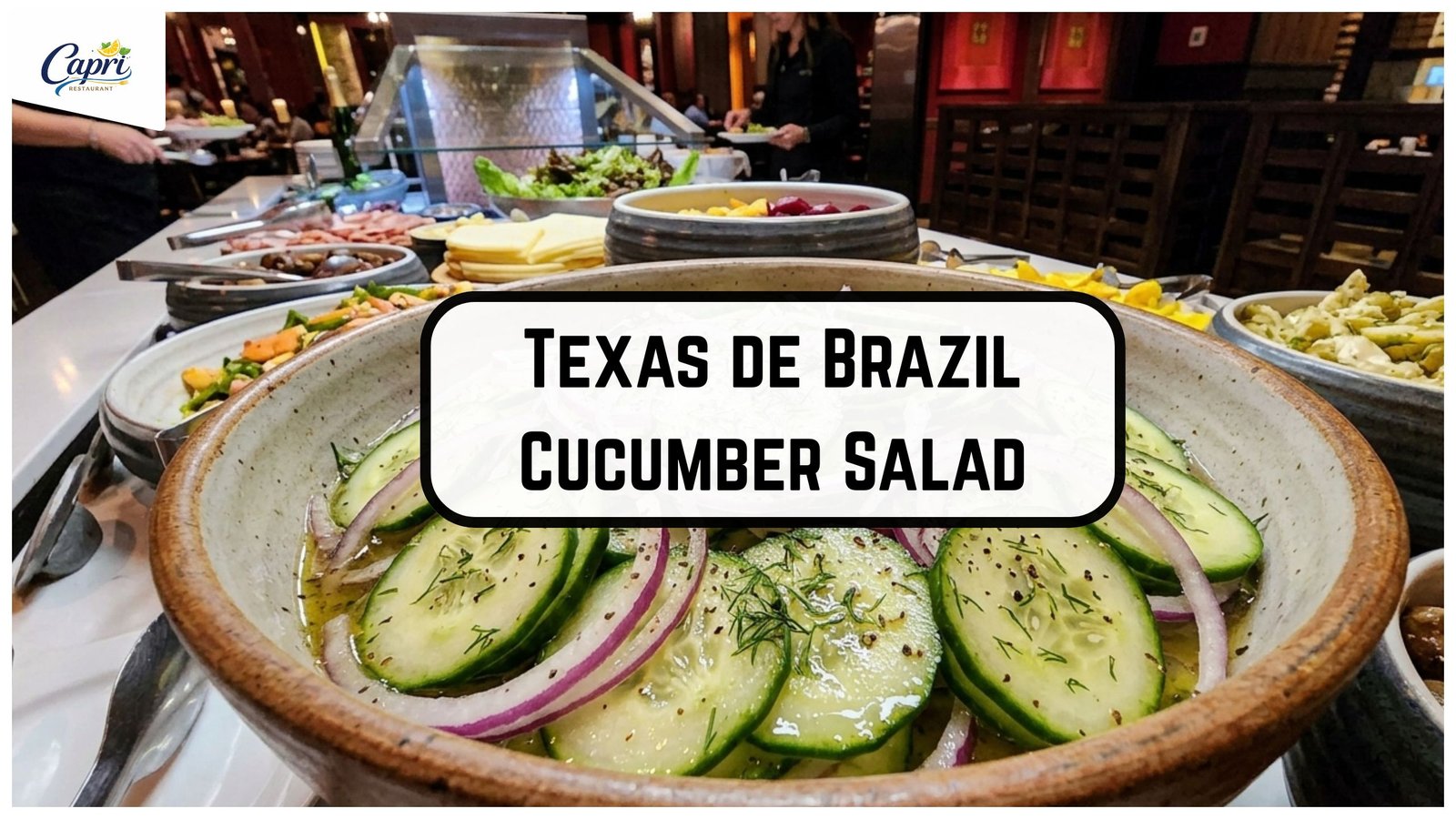

Texas de Brazil Cucumber Salad
Ingredients
Equipment
Method
- Step 1 — Slice the cucumbers and onionSet your mandoline to its thinnest setting and slice all four cucumbers into translucent rounds directly into your large mixing bowl. The goal is slices no thicker than 2–3mm — at this thickness they become almost lacey, absorbing the dressing beautifully while still holding a satisfying snap. Next, halve the red onion through the root and slice each half on the mandoline to the same thickness, then use your fingers to separate the layers into individual rings. If you don't own a mandoline, use a very sharp knife and work slowly — jagged or uneven slices will turn limp faster and won't present as elegantly
- Step 2 — Salt and draw out moistureAdd the teaspoon of sea salt to the bowl and toss the cucumber and onion slices together gently with your hands until the salt is evenly distributed. Set the bowl aside and let the vegetables sit uncovered for 20 minutes at room temperature. You'll notice a significant pool of liquid gathering at the bottom — this is exactly what you want. The osmosis process is pulling excess water out of the cucumber cells, which is the single most important step for preventing a soggy salad. Don't rush this; cutting it short means diluted dressing and limp cucumbers within minutes of serving:
- Step 3 — Drain and dry thoroughly:Turn the salted vegetables into a colander set over the sink and let them drain for 2–3 minutes, tipping the bowl to get every drop. Rinse lightly under cold running water to wash away excess surface salt — a brief rinse only, not a long soak — then drain again. Transfer the cucumbers and onion to a clean kitchen towel or a double layer of paper towels and press gently to remove as much remaining moisture as possible. The drier you get them at this stage, the better your dressing will cling and the crisper the finished salad will be.
- Step 4 — Whisk the vinaigrette base: In a small bowl or jar, combine the white wine vinegar, olive oil, fresh lemon juice, and sugar. Whisk vigorously for 30–45 seconds, or seal the jar and shake hard, until the oil and vinegar have formed a cohesive, slightly thickened emulsion — you'll see it go from separated streaks to a uniform, slightly cloudy mixture. If the oil and vinegar immediately separate when you stop whisking, keep going; a proper emulsion will hold together for at least a minute, which is long enough to coat all the vegetables before it breaks. Taste the dressing at this stage — it should be bright and tangy with just a hint of sweetness in the finish.
- Step 5 — Add garlic and seasonStir the minced garlic into the vinaigrette and let it sit for 2 minutes so the raw edge softens slightly into the acid. Add the freshly ground black pepper and stir again. Taste once more and adjust: if it's too sharp, add another ¼ teaspoon of sugar; if it tastes flat, add a small squeeze of lemon juice. The dressing should be assertive — it's going to coat and flavor a large volume of vegetables, so it needs to be bolder than you think when tasting it alone.
- Step 6 — Toss the salad gently. Transfer the dried cucumbers and onion to a clean, dry large bowl. Pour about three-quarters of the vinaigrette over the vegetables and toss gently using two large spoons or clean hands, turning from the bottom up rather than stirring aggressively. The goal is to coat every slice without bruising or breaking the cucumber. Once everything looks glossy and well-dressed, add more vinaigrette to taste — the amount needed varies slightly depending on how much liquid the cucumbers released and how salty they still are after draining.
- Step 7 — Fold in the fresh herbsSprinkle the chopped dill and parsley over the dressed salad and fold them in gently with a spatula or your fingers, distributing them evenly throughout. Reserve a small pinch of each herb to scatter over the top just before serving for a fresh, finished look. Adding the herbs at this stage — rather than into the dressing — protects their delicate texture and bright color, and means they won't have wilted and darkened by the time the salad reaches the table.
- Step 8 — Chill and let the flavors developCover the bowl tightly with plastic wrap or transfer the salad to an airtight container and refrigerate for at least 20 minutes before serving. During this resting time, the vinaigrette soaks into the cucumber and onion, the garlic mellows, and the herbs perfume the entire dish. The salad will also release a little more liquid as it sits — simply tip and drain any excess pooled dressing from the bowl before plating. Serve cold, directly from the refrigerator, with a fresh scattering of herbs on top.
Video
Notes
- The salt step is non-negotiable: Salting and draining the cucumbers for a full 20 minutes is what separates a crisp, restaurant-quality salad from a watery, diluted one. The cucumbers hold a surprising amount of moisture, and if it isn’t drawn out before dressing, it will bleed into the vinaigrette within minutes and wash away all the flavor you built.
- Use English cucumbers if you can: English (hothouse) cucumbers have thinner, more tender skin that doesn’t need peeling, fewer seeds, and a cleaner, more delicate flavor than standard field cucumbers. If standard cucumbers are all you have, peel them fully and scrape out the seedy core with a spoon before slicing.
- How to know it’s ready: The finished salad should look glossy and well-coated, with the cucumber slices slightly translucent at the edges. After chilling, the onion will have softened to a pleasant silkiness, and the dill aroma will be the first thing you smell when you lift the lid. If the cucumbers still smell strongly of raw vegetables rather than tangy vinaigrette, give them another 10 minutes in the fridge.
- Most common mistake — skipping the pat-dry step: Rinsing after salting but not drying is where many home cooks go wrong. Surface water on the vegetables dilutes the dressing immediately and prevents it from clinging. Take the extra 60 seconds to press them in a clean towel — it makes a tangible difference in the final texture.
- Variation — Spicy jalapeño version: Thinly slice 1–2 fresh jalapeños and toss them in with the cucumbers before dressing. The heat plays brilliantly against the cool, tangy vinaigrette and makes this an even more interesting partner for rich grilled meats.
- Variation — Feta and olive: Crumble 60g of good-quality feta cheese over the finished salad and add a small handful of pitted Kalamata olives, halved. This turns the dish in a Greek direction and adds a creamy, salty richness that works especially well alongside lamb.
- Variation — Asian-inspired sesame version: Swap the white wine vinegar for unseasoned rice vinegar, replace the olive oil with neutral oil, and add 1 teaspoon of toasted sesame oil and a pinch of chili flakes. Finish with toasted sesame seeds instead of dill. The result is a completely different salad that pairs beautifully with grilled chicken or pork.
- Make-ahead tip: This salad genuinely improves with time. Making it the night before or the morning of your event allows the garlic and herbs to fully permeate the cucumbers. Just drain any pooled liquid and add a fresh handful of herbs right before serving to restore the bright color.
- Storage: Store in an airtight container in the refrigerator for up to 3 days. The cucumbers will soften slightly over time, but the flavor deepens. Drain any accumulated liquid before serving and toss again to redistribute the dressing.
- Reheating: This salad is always served cold — no reheating required or recommended. If it has been in the fridge and the olive oil has solidified slightly, simply set it out at room temperature for 5 minutes and toss before serving.
- Freezing: Do not freeze. Cucumbers are over 95% water and will collapse into a mushy, unpleasant texture when thawed. This salad is not suitable for freezing under any circumstances.
- Dietary adaptations: This recipe is naturally vegan, dairy-free, and gluten-free as written. For a lower-sodium version, reduce the salting time to 10 minutes and do not add any additional salt to the dressing. For a no-added-sugar version, the teaspoon of sugar can be omitted or replaced with a small drizzle of honey (not vegan) or a few drops of liquid stevia.
- Serving suggestions: Serve alongside picanha, chicken thighs, or any grilled steak. It also works beautifully as a palate cleanser between courses at a larger spread, or as part of a mezze-style cold table with hummus, olives, and flatbreads. A cold caipirinha or sparkling water with lime alongside is the churrascaria-at-home experience.
- Scaling note: This recipe doubles easily for a crowd — simply work in two batches when salting and draining, as overcrowding the bowl reduces the efficiency of the salt-draw step. A full double batch serves 10–12 as a side dish.
What is the Texas de Brazil Cucumber Salad?
The Texas de Brazil Cucumber Salad is a cold, marinated side dish served at the Texas de Brazil churrascaria chain — a Brazilian steakhouse concept where gaucho-style grilled meats are carved tableside. Among the array of hot proteins and rich sides, this salad plays a precise and deliberate role: it is the cool, acidic counterpoint that resets the palate between bites of fire-kissed beef, lamb, and chicken.
At its core, the salad is paper-thin cucumber rounds and delicate red onion rings, salted to draw out their natural moisture, then dressed in a bright white wine vinaigrette sharpened with lemon juice and perfumed with fresh dill and flat-leaf parsley. Its simplicity is intentional — this is a dish built on texture and contrast, not complexity. The cucumbers are never soggy, the dressing never heavy, and the herbs are always vivid and fresh.
Where Does the Texas de Brazil Cucumber Salad Come From?
Texas de Brazil was founded in 1998 in Addison, Texas, blending the traditions of South Brazilian churrasco — the art of slow-roasting large cuts of meat over open coals — with the bold, abundant spirit of Texas hospitality. The cucumber salad draws from a broader tradition of vinegar-dressed vegetable salads common across Brazilian home cooking, where fresh, acidic sides are served alongside rich, fatty meats as both a palate cleanser and a digestive aid.
This style of marinated cucumber salad also carries echoes of Eastern European and Mediterranean cuisines, which is unsurprising given the significant German and Italian immigration to southern Brazil during the 19th and early 20th centuries. The result is a dish that feels simultaneously familiar and distinctly Brazilian in its context and presentation.
What Makes the Texas de Brazil Cucumber Salad Different From Other Cucumber Salads?
Most Western cucumber salads are either cream-based — built on sour cream or yogurt — or rely on heavy seasoning to compensate for watery, thick-cut cucumbers. The Texas de Brazil version is neither. Its two defining techniques set it apart: mandatory salting and draining to achieve a genuinely crisp, non-watery texture, and a restrained vinaigrette that lets fresh herbs carry the flavor rather than masking everything with dressing. The cucumbers are coated, not submerged, so every bite tastes more of the vegetable than the sauce. It is bracingly clean on the palate and intentionally light — a deliberate counterweight to everything else on the churrascaria table.
BENEFITS
1. It Resets Your Palate Between Meat Courses
At a churrascaria, the flavors of smoked picanha, garlic chicken, and seasoned lamb are bold and accumulative — after three or four cuts, the richness starts to blur together. The cucumber salad’s acidity acts as a palate reset, cutting through fat and preparing your taste buds for the next round. This is the same principle behind sorbet between courses in fine dining, just more practical and far less fussy.
2. It Genuinely Hydrates
Cucumbers are approximately 95% water by weight. Serving this salad alongside grilled meat — a meal that typically leaves guests feeling full and warm — provides a quiet but real hydration boost. The lemon juice and vinegar also stimulate saliva production, which aids digestion and keeps the mouth feeling fresh throughout a long, indulgent meal.
3. It Is Very Low in Calories
At around 85 kcal per serving, this salad adds essentially no caloric load to what is already a generous meal. The olive oil provides a small amount of healthy monounsaturated fat, but the overall profile is light. For guests who are watching their intake but don’t want to feel left out at a feast, this is the one dish on the table they can eat without any mental arithmetic.
4. It Delivers Real Micronutrients
Fresh dill is a surprisingly potent source of antioxidants and has been used in traditional medicine for its digestive and anti-inflammatory properties. Parsley is rich in Vitamin K and Vitamin C. Cucumbers contribute small but meaningful amounts of potassium, magnesium, and Vitamin K. None of this turns the salad into a superfood, but it means every serving is doing something nutritionally useful rather than just filling space on the plate.
5. It Is Naturally Vegan, Gluten-Free, and Dairy-Free
As written, this recipe accommodates nearly every common dietary restriction without any substitutions or modifications. There is no meat, no gluten, no dairy, and no eggs. This makes it one of the rare dishes at a meat-heavy spread that every single guest can eat without hesitation — a practical benefit that becomes very obvious the moment you’re hosting a mixed-diet table.
6. It Is a Make-Ahead Dish That Actually Improves Overnight
Unlike most fresh salads, which deteriorate the moment they’re dressed, the Texas de Brazil Cucumber Salad is one of those rare recipes that genuinely gets better with time. The vinaigrette penetrates the cucumber slices more deeply after several hours, the garlic mellows, and the herbs fully perfume the dish. Making it the morning of — or even the night before — removes a task from your day-of prep list and delivers a better result than if you’d made it fresh.
BEST COMBINATIONS
On the Churrascaria Table
The salad was designed to sit alongside grilled meat, and that is still where it performs best. These are the pairings that work most naturally:
- Picanha (Top Sirloin Cap): The classic Brazilian cut — heavily salted, seared over coals, sliced thin. Its rich fat cap and intensely savory crust are the exact opposite of this salad’s cool acidity. They are made for each other. A forkful of picanha followed immediately by a few cucumber slices is the full Texas de Brazil experience in two bites.
- Frango (Garlic Chicken Thighs): The herb notes in the salad’s vinaigrette — particularly the dill — echo and amplify the garlic and herb seasoning on grilled chicken. The combination feels cohesive rather than contrasting, more of a flavor harmony than a counterpoint.
- Lamb Chops or Leg of Lamb: Lamb has a strong, funky richness that needs something acidic and fresh to keep it from feeling heavy. The vinaigrette cuts through lamb fat cleanly, and the fresh herbs complement the meat’s natural earthiness.
- Linguiça (Brazilian Pork Sausage): Fatty, slightly spicy, and smoke-kissed — linguiça is best eaten alongside something bright and cool. The cucumber salad is ideal here, taming the richness and providing textural contrast to the sausage’s dense, chewy bite.
Beyond the Steakhouse
The salad travels well beyond its original context. These combinations work just as well at home:
- Backyard Burgers and Grilled Brats: Serve this in place of (or alongside) coleslaw. The vinaigrette is lighter than a mayonnaise-based slaw and holds up better in summer heat without risk of spoiling.
- Grilled Fish Tacos: The cucumber and dill combination echoes the flavors of a classic tzatziki or Nordic-style garnish. Pile the dressed cucumbers into fish tacos alongside cabbage and lime crema for an unexpected but brilliant layering of acid and freshness.
- Mezze or Cold Spread: Serve alongside hummus, warm pita, olives, and roasted red peppers for a cold table that needs something crisp and tangy. The salad anchors the spread without competing with any other element.
- Rice and Beans (Feijão): The traditional Brazilian pairing of white rice and black bean stew (feijão preto) is rich, starchy, and deeply savory. The cucumber salad alongside it provides exactly the lift the meal needs to feel balanced rather than heavy.
- As a Sandwich Topping: Drain a small portion of the dressed cucumbers and layer them inside a grilled chicken sandwich, a bánh mì-style roll, or a lamb flatbread wrap. The vinegary crunch plays the same role as pickles, but with more herbaceous complexity.
Drinks That Pair Well
- Caipirinha: Brazil’s national cocktail — cachaça, lime, and sugar — mirrors the salad’s sweet-tart profile and is the most natural pairing imaginable.
- Cold Lager or Pilsner: Light, crisp beer cuts through grilled meat fat and complements the salad’s clean flavors without overwhelming the fresh herbs.
- Sparkling Water with Lime: For non-drinkers, the effervescence and acidity of sparkling lime water echo the salad’s vinaigrette and keep the palate fresh throughout the meal.
- Dry Rosé: A bone-dry Provençal rosé has the acidity and minerality to complement the vinaigrette without clashing with the herbs.
Yes — and you should. The salad improves significantly after 2–4 hours in the refrigerator, as the vinaigrette has time to fully penetrate the cucumber slices and the garlic mellows. Make it the morning of your event and refrigerate until ready to serve. Before plating, drain any excess liquid that has pooled at the bottom and toss gently to redistribute the dressing. Add a fresh pinch of dill and parsley on top to restore the bright color.
There are two likely causes. First, the salting step was either skipped or cut short — cucumbers need a full 20 minutes with salt to release their internal moisture before being dressed. Second, the cucumbers weren’t dried thoroughly enough after draining. After rinsing, press them firmly in a clean kitchen towel or double layer of paper towels until no more moisture transfers. Both steps are essential, and skipping either one results in a diluted, watery dressing within minutes of serving.
No, but it makes a significant difference. The texture of this salad depends on the cucumbers being sliced at 2–3mm thickness — thin enough to be almost translucent and to absorb the dressing fully. A very sharp chef’s knife can achieve this, but it requires patience and a steady hand. If your slices are uneven or thicker than 3–4mm, the salad will still taste good but won’t have the same elegant, lacey texture as the restaurant original.
Technically yes, but the result will be noticeably different. Dried dill has a flat, dusty quality that lacks the bright, grassy fragrance of fresh. This recipe uses relatively few ingredients, so each one has an outsized impact on the final flavor — fresh dill is one of the salad’s two defining characteristics. If fresh dill is unavailable, fresh mint or fresh tarragon are more interesting substitutes than dried dill.
English (hothouse) cucumbers are ideal. They have thin, tender skin that doesn’t need to be peeled, very few seeds, and a cleaner, more delicate flavor than standard field cucumbers. If you’re using standard field cucumbers, peel them fully and scrape out the seedy core with a spoon before slicing — the seeds hold extra water and can make the salad bitter if left in.
Absolutely. Thinly sliced radishes add a peppery crunch and a beautiful pink color. Thin rounds of fennel contribute an anise note that pairs well with the dill. Cherry tomatoes, halved, add sweetness and color but release additional liquid, so add them just before serving rather than marinating them with the cucumbers. Thinly sliced celery adds an earthy crunch without competing with the vinaigrette.
Yes, with one caveat. The salad keeps well for up to 3 days in an airtight container in the refrigerator. The cucumbers will soften slightly by day 2 and 3, but the flavor deepens and improves. Drain any accumulated liquid before serving each time, and add a fresh handful of herbs if you want to restore the visual brightness. Do not freeze — cucumbers lose all their texture when thawed and become unpleasantly mushy.
Add sugar in small increments — ¼ teaspoon at a time — whisking and tasting after each addition. You can also add a small splash more of olive oil to soften the acidity without making the dressing sweeter. If the whole salad already tastes too sharp after tossing, a very small drizzle of honey stirred through at the end can rescue it without making it taste sweet.
It already is. The base recipe contains no animal products and no gluten-containing ingredients. The only thing to check when adding variations is feta cheese (dairy) if you’re making the feta-and-olive version, or honey if you’re using it to balance the dressing (not vegan). Every other element of the recipe is naturally plant-based and gluten-free.
For 6 servings, expect to spend between $4 and $7 depending on your location and whether you’re buying English cucumbers versus standard field cucumbers. The most variable costs are the fresh herbs (dill especially) and the quality of olive oil you use. None of the ingredients are expensive, and most are pantry staples you likely already have. It is one of the most cost-effective side dishes you can put on a table.