
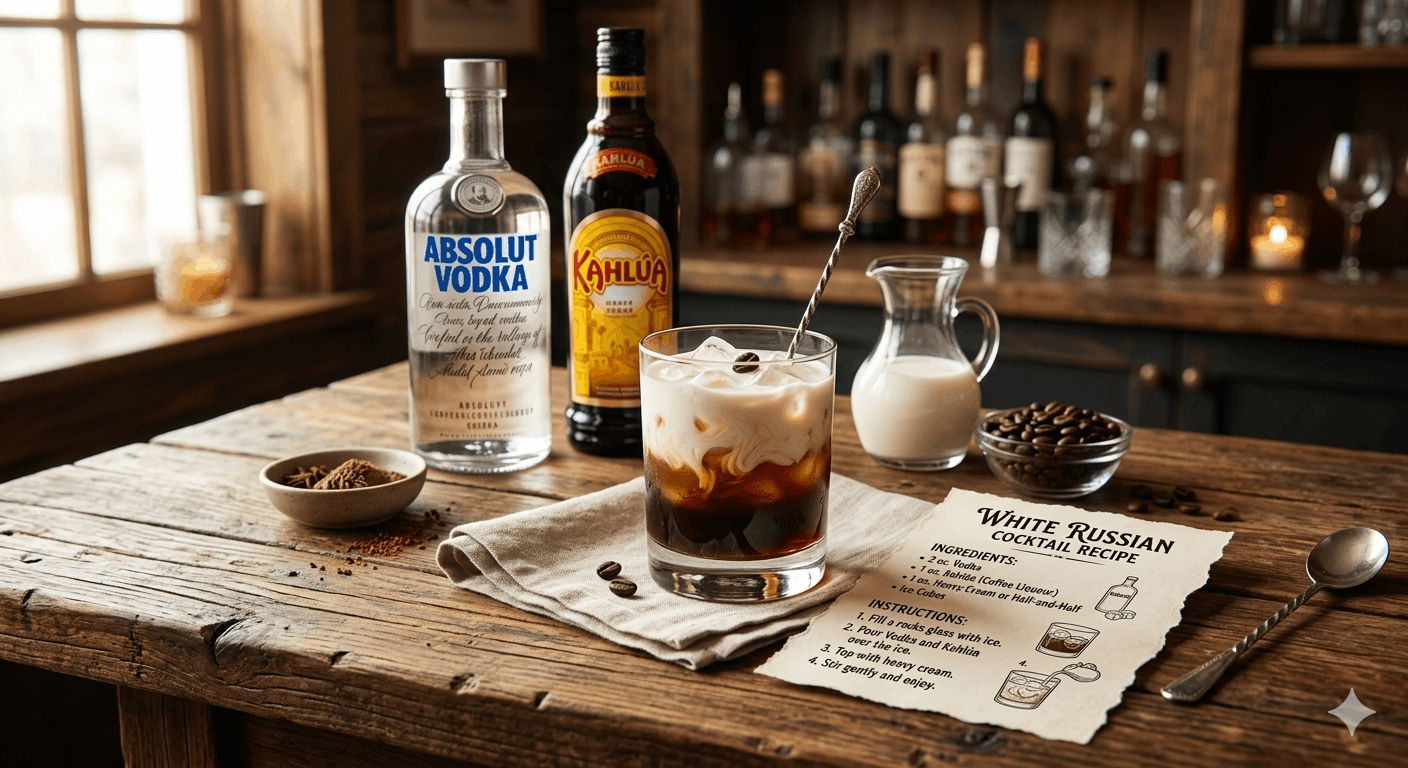

White Russian Cocktail Recipe
Ingredients
Equipment
Method
- Step 1 — Chill the glass and fill with iceIf time allows, place your rocks glass in the freezer for 5 minutes before building the drink — a chilled glass keeps the cocktail colder for longer and slows the ice from melting into the cream. When ready, fill the glass nearly to the top with ice. Use the largest ice cubes you have: a single large cube or ice sphere melts significantly slower than standard cubes, which means the drink stays colder and more concentrated longer. A glass packed with small ice cubes is the most common mistake made at home — the high surface area melts quickly, diluting the cocktail within minutes and washing out the cream's richness.
- Step 2 — Add the vodka and Kahlúa. Pour the vodka over the ice first, followed by the Kahlúa. The order matters slightly: the vodka goes in first to begin chilling against the ice, and the darker, slightly more viscous Kahlúa settles just below the vodka layer, setting up the foundation for the cream float. Give the two spirits a brief stir with a bar spoon — 3 to 4 rotations only — to chill them against the ice without fully diluting them. The goal is a cold base, not a watered-down one.
- Step 3 — Float the creamThis is the step that separates a properly made White Russian from a rushed one. Hold a bar spoon face-down just above the surface of the vodka-Kahlúa mixture, with the tip of the spoon touching or barely hovering above the liquid. Pour the heavy cream very slowly over the back of the spoon in a thin, steady stream. The spoon disperses the energy of the falling cream and allows it to slide gently onto the surface of the drink rather than plunging through it. Done correctly, the cream will sit in a distinct, cloud-like layer on top, with the dark coffee liqueur visible just below — this is the signature look of a classic White Russian. If you pour the cream too quickly or without the spoon, it sinks immediately and you lose the visual effect.
- Step 4 — Garnish and serveIf using, grate a light dusting of fresh nutmeg over the cream using a microplane or fine grater. The volatile oils in fresh nutmeg bloom immediately on contact with the cream and add an aromatic warmth that is not present with pre-ground nutmeg. Serve immediately with a stirrer or bar spoon on the side — the traditional way to enjoy a White Russian is to let the cream float for the first sip, experiencing the contrast of creamy and bitter-sweet, then stir once or twice to integrate everything into a unified, silky cocktail for the remainder of the drink.
Video
Notes
- The cream float is the technique that matters most: Pour slowly over the back of a bar spoon, and you get the beautiful layered look that defines the drink. Rush it and the cream sinks, the cocktail looks muddy, and you lose the textural contrast that makes the first sip special. Thirty extra seconds of patience is all it takes.
- Ice quality changes the drink: Small cubes dilute rapidly and turn a well-made White Russian watery within minutes. Use the largest ice you can — a 2-inch cube or a sphere — and fill the glass nearly to the top. The more ice, the slower it melts, and the more the drink retains its integrity throughout.
- Kahlúa is the right choice, and here’s why: Kahlúa is made with rum, arabica coffee, and vanilla — a combination that produces a coffee liqueur with genuine complexity: coffee bitterness, vanilla sweetness, and a gentle caramel note that maps perfectly onto the vodka and cream. Budget coffee liqueurs skip the quality coffee and vanilla and taste flat and sugary by comparison. Mr. Black (Australian) is an excellent premium alternative with a stronger, more bitter coffee character.
- How to know when it’s perfect: The ideal White Russian looks like a dark amber base with a white cloud floating on top. The cream maintains its float for a full 30–60 seconds before beginning to marble downward. The drink tastes rich and coffee-forward on first sip when un-stirred, and becomes uniformly creamy and balanced when stirred.
- Most common mistake — over-stirring before the cream float: Vigorous stirring after adding the cream immediately incorporates it into the drink and erases the layered presentation. Stir the vodka and Kahlúa gently before adding the cream. After the cream is floated, stir only when you are ready to integrate everything for the final sips.
- Variation — Espresso White Russian: Add 1 shot of freshly pulled espresso (cooled slightly) to the vodka and Kahlúa before adding the cream. The fresh espresso intensifies the coffee character significantly and adds a genuine bitterness that balances the sweetness of the Kahlúa. This is the most recommended variation for coffee lovers.
- Variation — Baileys White Russian: Replace the heavy cream with an equal measure of Baileys Irish Cream. The Irish cream adds whiskey and chocolate notes alongside the cream’s richness, making the drink sweeter, more confection-like, and slightly higher in alcohol. A particularly good choice during the holiday season.
- Variation — Peppermint White Russian: Add ¼ oz of peppermint schnapps alongside the Kahlúa. The mint and coffee combination is a natural one, and the cream softens the sharpness of the schnapps. Best served December through January when the mint-chocolate mood is in full effect.
- Variation — Colorado Bulldog: Add a small splash (1–2 oz) of cola over the cream float at the very end. The cola adds carbonation and a slight caramel-vanilla note that makes this a lighter, more refreshing take on the White Russian. Popular as an afternoon drink or at casual parties.
- Variation — Ice Cream White Russian: Skip the ice and the cream entirely, and instead add one generous scoop of good vanilla ice cream to the vodka and Kahlúa. The ice cream melts slowly into the spirits, creating a spiked coffee milkshake effect that requires no blender and no effort. Arguably better than the original. Coffee, caramel, or chocolate ice cream also work beautifully.
- Dairy-free version: Full-fat canned coconut milk (not coconut cream drink, but the thick canned kind) produces the best dairy-free float — it has enough fat content to sit on the surface similarly to heavy cream. Oat milk barista blend is a reasonable second choice. Almond and rice milk are too thin to float and will sink immediately.
- Make-ahead for a crowd: Combine the vodka and Kahlúa in the correct ratio in a pitcher or bottle and refrigerate up to 24 hours in advance. When ready to serve, fill glasses with ice, pour 3 oz of the pre-mixed base per glass, and float the cream to order. This eliminates most of the work during serving without compromising quality.
- Scaling note: The 2:1:1 ratio (2 parts vodka, 1 part Kahlúa, 1 part cream) is the widely accepted modern standard and produces a slightly spirit-forward cocktail with good balance. The original equal-parts 1:1:1 recipe is sweeter and creamier — excellent for non-spirit drinkers. Adjust freely to your palate.
White Russian Cocktail: About, History, Nutrition, Benifits and Best Combination
The Cocktail at a Glance
The White Russian is a built cocktail — meaning it is assembled directly in the serving glass rather than shaken or stirred in a separate vessel — made from exactly three ingredients: vodka, coffee liqueur, and heavy cream. Its defining characteristic is the cream float: heavy cream poured slowly over the back of a spoon so that it rests on the surface of the vodka-and-coffee-liqueur base in a distinct, swirling layer, creating a two-toned drink that is visually striking before a single sip is taken. It is simultaneously one of the simplest cocktails to make and one of the most recognizable in the world.
In flavor terms, it occupies the territory between cocktail and dessert — the coffee liqueur provides sweetness and bitter-coffee depth, the vodka contributes clean alcoholic warmth, and the cream rounds everything into a silky, rich mouthfeel that is more reminiscent of a gourmet coffee drink than a traditional spirit-forward cocktail. For this reason, it has unusually wide appeal: bourbon drinkers find it satisfying, wine drinkers find it accessible, and people who rarely drink anything alcoholic find it approachable and genuinely pleasurable.
The Origin Story
The White Russian traces its lineage directly to the Black Russian, which appeared first. The Black Russian — simply vodka and coffee liqueur over ice — is generally attributed to Gustave Tops, a Belgian bartender working at the Hotel Métropole in Brussels in 1949, who created it to honor Perle Mesta, the U.S. Ambassador to Luxembourg. The White Russian followed some years later: the earliest documented mention in print appears in a 1955 advertisement in a California newspaper, and the cream addition is most plausibly a bartender’s natural impulse to soften and enrich the rather blunt Black Russian with a dairy element.
For decades, the White Russian was a moderately popular bar order with a somewhat fussy reputation — a drink for people who wanted something sweet and creamy rather than a proper cocktail. Then, in 1998, the Coen Brothers released The Big Lebowski, and Jeff Bridges’ character “The Dude” consumed White Russians throughout the film with the kind of unhurried devotion usually reserved for fine Scotch. The drink’s popularity surged overnight and has never fully retreated. Today, it occupies a peculiar cultural position as both a cult classic and a genuine bartending staple — ironic and earnest at the same time, beloved by cocktail enthusiasts and casual drinkers alike.
What Makes It Different From Other Cream Cocktails
Many cream cocktails — a Brandy Alexander, a Grasshopper, an Irish Coffee — rely on cream as a softener for a spirit or liqueur that is already complex and flavorful. The White Russian uses cream differently: it floats the cream rather than integrating it, creating a textural and visual experience that is unique to this drink. The first sip, taken through the cream layer, delivers a different ratio of ingredients than the last sip at the bottom of the glass — a designed inconsistency that invites the drinker to experience the drink in stages. The stir, when it comes, transforms the cocktail entirely, producing a smooth, unified, latte-like finish. No other cream cocktail offers this two-act structure, and it is the detail that makes the White Russian memorable rather than merely pleasant.
NUTRITION
Calories: Approximately 317–325 kcal (per 1 cocktail, using heavy cream)
| Nutrient | Per Cocktail |
|---|---|
| Protein | 1g |
| Total Fat | 11g |
| Saturated Fat | 7g |
| Carbohydrates | 14g |
| Sugar | 14g |
| Sodium | 10–20mg |
| Cholesterol | 32–41mg |
| Alcohol | ~22–25g |
Values are approximate and vary based on the exact vodka proof, coffee liqueur brand, and amount of cream used. A lighter version using half-and-half will be approximately 220–250 kcal.
BENEFITS
1. It Is Genuinely Beginner-Friendly With Zero Learning Curve
Three ingredients, no shaker, no straining, no technique beyond a careful cream pour — the White Russian can be made correctly on the very first attempt by someone who has never mixed a cocktail before. The floating cream technique looks impressive but requires only a bar spoon and patience. Unlike a Negroni (which requires understanding bitter balance), an Old Fashioned (which requires muddling and ratio judgment), or a Martini (which requires an opinion on shaking versus stirring), the White Russian asks only that you pour slowly. This accessibility makes it the ideal first cocktail for anyone who wants to host without anxiety.
2. It Has the Broadest Possible Guest Appeal of Any Spirits-Based Cocktail
In a group of six people with varying drink preferences, a White Russian is more likely to be enjoyed by all six than almost any other cocktail. Its sweetness appeals to those who prefer wine or dessert; its cream masks the alcohol for those sensitive to spirits; its coffee depth satisfies those who want something substantive; its simplicity means those who prefer beer will still understand and appreciate it. It is the most diplomatically sound cocktail a host can put on a table.
3. It Can Be Batched Effortlessly for Parties
Scaling the White Russian to a crowd requires nothing more than multiplying the vodka and Kahlúa quantities and storing the premixed base in the refrigerator. A guest or a bartender can pour the base over ice and add the cream float to order in under 30 seconds per drink. No shakers, no timing, no last-minute juggling. For a gathering of 10, prepare a 600ml vodka / 300ml Kahlúa mixture in advance — the only task remaining during the party is the cream pour.
4. The Coffee Liqueur Contains Real Caffeine
Kahlúa and other quality coffee liqueurs are made with real coffee beans, which means each White Russian contains a small but genuine dose of caffeine — approximately 5–10mg per drink depending on the brand. This is not enough to keep anyone awake but is enough to add a slight alertness that other spirits-based cocktails lack. For an after-dinner drink context, the combination of a modest caffeine boost from the coffee liqueur and the warming effect of the vodka makes the White Russian an unusually pleasant transitional drink between dinner and the rest of an evening.
5. The Cream Provides Genuine Satiety
The 1 oz of heavy cream in a White Russian contributes approximately 10g of fat and 100 calories — enough to register as genuinely filling in the way that a gin cocktail or a glass of wine simply does not. This satiating quality means that one White Russian often serves the purpose that two or three lighter drinks might: the drinker feels satisfied and comfortable rather than drinking toward satiety that never quite arrives. For responsible and moderate consumption, the White Russian’s richness is a practical benefit.
6. It Is One of the Most Photographable Cocktails in Existence
The cream float — ivory white swirling against deep amber-brown in a clear rocks glass, backlit and served on a dark surface — is objectively beautiful and requires zero styling effort to photograph compellingly. In an era where food and drink photography is ubiquitous across social media, the White Russian essentially presents itself. This is not a trivial benefit for anyone who hosts gatherings, runs a hospitality business, or maintains a food and drink presence online.
BEST COMBINATIONS
When to Serve It and Why
The White Russian occupies a specific temporal slot in any gathering: it is definitively an after-dinner drink, not an aperitif. Its richness and sweetness are satisfying after a meal in a way that would overwhelm the appetite before one. The caffeine in the coffee liqueur gives it a gentle second-wind quality that makes it appropriate for extending an evening rather than starting one. Serve it at the point in a dinner party when the dessert dishes have been cleared, the conversation has become easier, and no one is in any particular hurry to leave.
Food Pairings
- Tiramisu: The most natural pairing imaginable. Tiramisu uses espresso, mascarpone cream, and a coffee-soaked sponge — essentially the same flavor language as the White Russian. Serving the cocktail alongside or just after tiramisu creates a completely coherent, deeply satisfying coffee-and-cream finish to a meal.
- Dark chocolate: A square or two of 70%+ dark chocolate alongside a White Russian is a straightforward pairing that works because the bitterness of dark chocolate and the bitterness of coffee are complementary, and both are softened by the cream. A chocolate truffle works even better — the ganache center echoes the creaminess of the cocktail.
- Vanilla ice cream: A scoop of good vanilla bean ice cream served alongside rather than inside the cocktail is elegant, simple, and creates a natural opportunity for the guest to stir a spoonful into the drink — a small, interactive pleasure.
- Pecan pie or walnut tart: The caramel, nut, and vanilla notes of pecan pie play directly into the Kahlúa’s vanilla-and-brown-sugar character. The cream in the cocktail mirrors the whipped cream most people would put on the pie.
- Cheesecake: The tangy richness of a plain or New York-style cheesecake and the sweet-coffee-cream of the White Russian form a dessert pairing with genuine complementarity — the slight acidity of the cheesecake cuts through the Kahlúa’s sweetness and refreshes the palate between sips.
- Biscotti or shortbread: For a lighter pairing, a buttery biscotti or a square of shortbread provides a clean, not-too-sweet accompaniment that does not compete with the cocktail’s flavor but offers a satisfying textural contrast between sips.
Cocktail Progressions and Menus
- After a light dinner, A White Russian served after a simple pasta or fish dinner works well precisely because the cocktail provides the richness that the meal deliberately withheld.
- As a dessert substitute: If dessert is not being served, a White Russian functions very effectively as a sweet, satisfying close to a meal — particularly if you add the espresso variation, which makes the coffee character more prominent and the dessert quality more explicit.
- Holiday cocktail menu: The White Russian is most frequently encountered at holiday gatherings, where its warmth, richness, and coffee-cream profile feel seasonally appropriate. Alongside a hot mulled wine or a spiked eggnog, it represents the more cocktail-forward end of a holiday drinks menu.
- Preceded by: An Aperol Spritz, a light white wine, or a classic gin and tonic — all aperitif-appropriate and light enough that the White Russian’s richness lands as a satisfying contrast rather than an additional burden.
Spirit and Liqueur Swaps Worth Trying
- Vodka → Bourbon: Produces a deeper, warmer, more complex cocktail sometimes called a White Kentuckian or simply a Bourbon Russian. The caramel and vanilla in the bourbon mirror the Kahlúa’s vanilla notes and add a wood-aged depth that the vodka cannot. One of the best and most under-appreciated variations.
- Vodka → Dark rum: A White Cuban — rum, Kahlúa, and cream — is a Caribbean-inflected version with molasses sweetness and funkiness that makes it more interesting than the original to many palates.
- Kahlúa → Amaretto: The White Belgian — vodka, amaretto, and cream — swaps coffee for almond and produces a sweeter, more marzipan-like cocktail that is exceptional with chocolate desserts.
- Heavy cream → Baileys Irish Cream: Adds whiskey and chocolate notes; the result is sweeter, heavier, and more spirit-forward. Excellent but not for those seeking subtlety.
RESPONSIBLE DRINKING — ALCOHOL AWARENESS
Please Drink Responsibly
The White Russian is a deceptively strong cocktail. Its creamy, dessert-like flavor masks the alcohol very effectively, which means it is often consumed more quickly — and in greater quantity — than its strength warrants. Each standard serving contains approximately 2 oz of 40% ABV vodka and 1 oz of 20% ABV coffee liqueur, making it a moderately strong drink at roughly 23–25% ABV after dilution from ice. Awareness and moderation are essential.
How Many Is Too Many — Understanding the 6 to 7 Pint Equivalent Warning
A single White Russian (2 oz vodka + 1 oz Kahlúa) contains approximately 2.5–3 standard units of alcohol, depending on the vodka’s proof. This means that consuming 3 White Russians in a session is equivalent in alcohol content to drinking 6 to 7 pints of regular-strength beer — a level that places most people well above the legal driving limit in virtually every country, significantly impairs judgment and coordination, and substantially increases the risk of alcohol-related harm. For perspective, 6 to 7 pints of beer in a single session is considered heavy, binge-level drinking by medical standards in the UK and the US alike.
Practical Guidelines for Responsible Enjoyment
- Stick to 1–2 White Russians per session. Given each drink’s unit content, this keeps most adults within or close to the recommended weekly guidance of 14 units for regular drinkers, spread across multiple occasions.
- Pace yourself — one drink per hour minimum. The body metabolizes approximately 1 standard unit of alcohol per hour. A White Russian with 2.5–3 units takes 2.5 to 3 hours to fully clear. Drinking faster than this causes rapid accumulation.
- Never drive after drinking. Even one White Russian can push some people above the legal blood alcohol limit for driving, particularly those with lower body weight, lower alcohol tolerance, or those who have not eaten. If you plan to drive, do not drink.
- Eat before and during. Food, particularly fat- and protein-rich food, slows the absorption of alcohol into the bloodstream significantly. The White Russian’s cream provides some buffer, but eating a proper meal before drinking is far more effective.
- Alternate with water. Between each White Russian, drink a full glass of water. Alcohol is a diuretic and contributes to dehydration that worsens the after-effects of drinking. Staying hydrated does not prevent intoxication but reduces next-day discomfort meaningfully.
- Be aware of the “easy drinking” effect. The cream and sweetness in a White Russian disguise the alcohol in a way that a neat spirit or a wine does not. You may not feel as drunk as you are. Trust the clock and the unit count, not how you feel.
Who Should Not Drink This Cocktail
- Anyone under the legal drinking age in their country, in most countries 18 or 21 years old. Alcohol at any level causes disproportionate harm to developing brains and bodies.
- Pregnant individuals. There is no established safe level of alcohol during pregnancy. This cocktail, like all alcoholic drinks, should not be consumed during pregnancy.
- Anyone taking medication that interacts with alcohol, including but not limited to antibiotics, antidepressants, blood thinners, antihistamines, and sleeping pills. Consult your doctor or pharmacist if unsure.
- Anyone who has been advised by a healthcare professional to avoid alcohol for any reason.
- Anyone planning to drive, operate machinery, or undertake any activity requiring full coordination and judgment within several hours of consumption.
If You Choose Not to Drink Alcohol
A non-alcoholic White Russian is easy to make and genuinely delicious. Combine cold brew coffee concentrate (2 oz), non-alcoholic coffee syrup or Kahlúa 0% (available in most supermarkets), and heavy cream floated over the back of a spoon exactly as in the original recipe. The result has the same layered visual beauty, the same creamy coffee richness, and none of the alcohol content. Serve it the same way, with the same glassware and garnish, for a drink that is fully inclusive at any gathering.
FAQs
The Black Russian contains only vodka and Kahlúa, served over ice with no cream. It has a stronger, more direct coffee flavor and a more pronounced alcohol presence. The White Russian adds heavy cream, which transforms the drink entirely: richer, creamier, more dessert-like, and the alcohol retreats behind the coffee-and-cream combination. The White Russian is the more popular version by a wide margin, but the Black Russian is the better choice when you want something more spirit-forward and less sweet.
Q: Can I make a White Russian without Kahlúa? Yes — any coffee liqueur works. Mr. Black has a stronger, less sweet, more bitter coffee character that many people prefer for a more grown-up result. Tia Maria has a slightly lighter, more refined coffee note. In a pinch, cold brew concentrate combined with simple syrup approximates the flavor, though without the rum base of a proper coffee liqueur, the complexity will be noticeably thinner.
Two reasons. First, you are pouring too fast — the cream needs to be poured in a thin, gentle stream. Second, you are not using the back of a spoon to break the fall. Hold the spoon face-down over the drink and pour over the convex back — the cream will slide off the spoon and land gently. If using half-and-half or milk rather than heavy cream, these are much harder to float because the lower fat content reduces the density difference needed to keep them on the surface.
Moderately — and more so than it tastes. The cream and sweetness mask the alcohol very effectively. At approximately 23–25% ABV after ice dilution, it sits between a glass of wine and a neat spirit. Each drink contains roughly 2.5–3 standard units of alcohol. Three drinks in a sitting equals the alcohol content of 6 to 7 pints of regular beer. Drink slowly and be honest with yourself about your intake.
Pre-batch the vodka and Kahlúa up to 24 hours in advance in a sealed container in the refrigerator. Float the cream to order when serving — never add it in advance, as it will integrate, and you will lose both the visual layered effect and the textural contrast. Per-drink assembly from the batched base takes about 30 seconds.
Yes. Use cold brew concentrate for the coffee element and a non-alcoholic coffee syrup or Kahlúa 0% for the liqueur, combined in the same ratios. Float regular heavy cream over the back of a spoon exactly as in the original. The result has the same layered appearance, the same coffee-and-cream flavor, and no alcohol content whatsoever.
A clean, neutral mid-range vodka — Tito’s, Absolut, or Smirnoff are consistent performers. Grey Goose and Belvedere are excellent at a higher price point. Kirkland (Costco) performs very well in blind taste tests for the price. Avoid heavily flavored vodkas, which conflict with the Kahlúa.
No — both approaches are legitimate. Un-stirred, you experience distinct phases: the first sip is almost purely creamy, deepening toward coffee and vodka as you drink further. Stirred, the drink is uniform from first sip to last. Most bartenders recommend taking one or two sips un-stirred to experience the layers, then stirring once for the rest of the drink.
Reduce the Kahlúa to ¾ oz and increase the vodka to 2.5 oz, maintaining total volume. Alternatively, substitute Mr. Black coffee liqueur, which contains significantly less sugar and produces a markedly drier, more bitter-coffee-forward result. Using half-and-half instead of heavy cream also slightly reduces perceived sweetness by thinning the texture.