At Capri Restaurant, we have a firm belief: a great side dish doesn’t just accompany a meal — it competes with the main course for the last spot on the plate. These Yard House Crispy Brussels Sprouts do exactly that. Blanched until just tender, roasted at high heat until their cut faces caramelize to a deep golden sear, then tossed in a glossy sweet-savory glaze of soy sauce, balsamic vinegar, honey, and garlic — and finished with crispy bacon bits, freshly grated Parmesan, and candied pecans — this is the dish that converts lifelong Brussels sprout skeptics on the very first bite. We’re proud to bring this beloved restaurant recipe into your home kitchen, step by step.
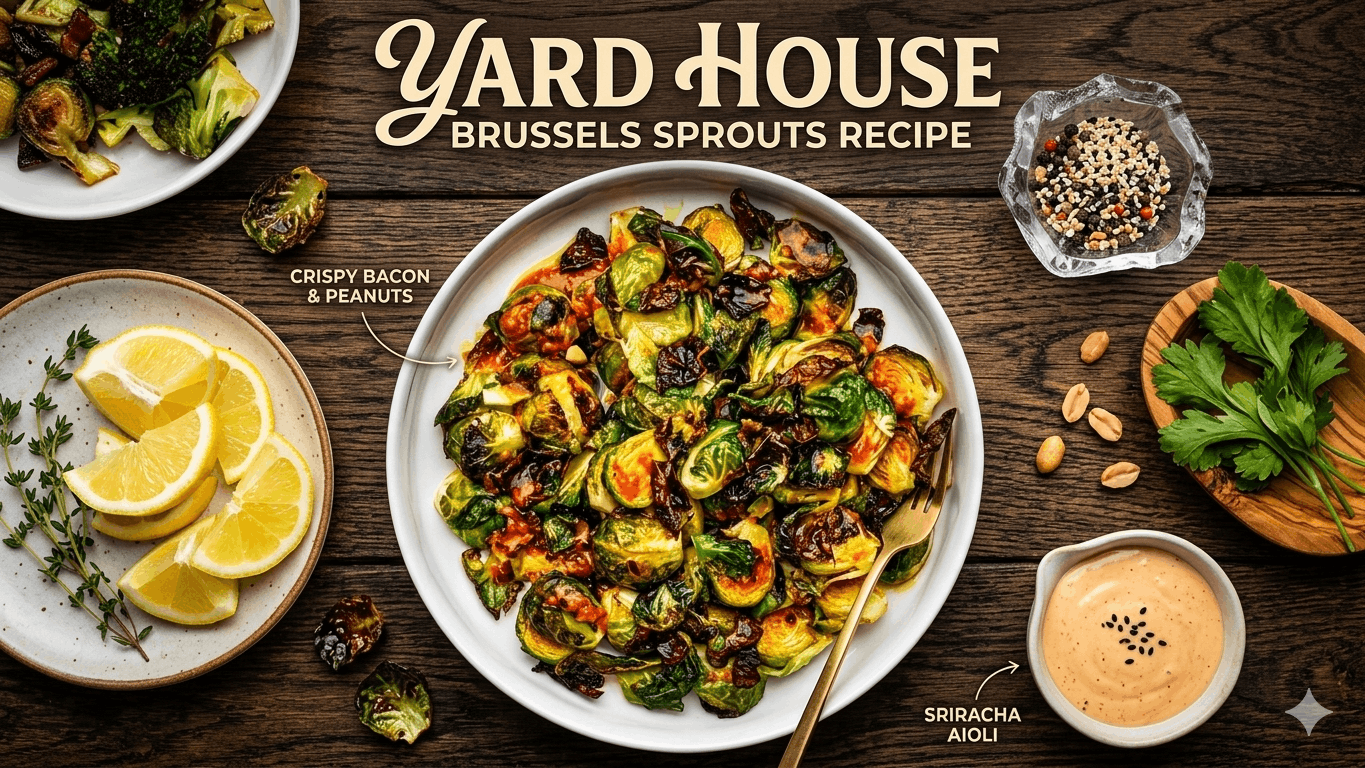

Yard House Crispy Brussels Sprouts Recipe
Ingredients
Equipment
Method
- Step 1 — Trim and halve the Brussels sprouts. Working with a sharp knife on a stable cutting board, trim only the very tip of the stem end from each Brussels sprout — just enough to reveal a fresh white interior, but not so much that the leaves come loose from the base. Slice each sprout in half lengthwise from stem to tip, creating two flat-faced halves. If any sprout is particularly large (bigger than a golf ball), cut it into quarters so it cooks at the same rate as the smaller ones — size uniformity is essential for even roasting. As you work, pull away any yellowed or loose outer leaves and discard them; these are signs of age and will burn before the rest of the sprout is done.
- Step 2 — Blanch in well-salted boiling water. Bring your large pot of water to a full rolling boil over high heat and add 1½ tablespoons of kosher salt — the water should taste noticeably salty, like a mild soup. Carefully lower the halved Brussels sprouts into the boiling water and blanch for exactly 5–6 minutes, until the interiors are just tender when pierced with a thin knife but the outer leaves still have some firmness. This blanching step is the technique secret that separates restaurant-quality crispy sprouts from home-kitchen versions: it pre-cooks the interior so the oven's high heat can focus entirely on building the caramelized crust without burning the outside before the inside is done. Drain immediately in a colander and spread the sprouts in a single layer on a clean kitchen towel.
- Step 3 — Dry the sprouts thoroughly. Pat the blanched sprouts firmly dry with the kitchen towel or paper towels, pressing down to absorb as much surface moisture as possible, and allow them to steam-dry on the towel for 5 minutes in a single layer. This drying step is not optional — it is the difference between crispy and soggy. Water on the surface of the sprouts creates steam in the hot oven, and steam prevents caramelization; every drop of moisture you remove now translates directly to more crispiness in the finished dish. If you have time, spread the dried sprouts on a clean tray and let them air-dry at room temperature for an additional 10–15 minutes for even better results.
- Step 4 — Preheat the oven and season the sproutsSet your oven to 425°F and allow it to fully preheat — place an oven rack in the upper-middle position for the best heat circulation. While the oven heats, transfer the dried Brussels sprouts to a large mixing bowl. Drizzle the olive oil over them and sprinkle with the ½ teaspoon of kosher salt and black pepper. Toss until every cut surface is evenly coated in oil — use your hands if needed, as they are the most effective tool for ensuring even coverage on the irregular surface of halved sprouts. Lay the oiled sprouts on your parchment-lined baking sheet in a single layer, positioning every single one cut-side down — this is non-negotiable. The flat cut face is where caramelization happens, and it must be in direct contact with the hot pan.
- Step 4 — Preheat the oven and season the sproutsSet your oven to 425°F and allow it to fully preheat — place an oven rack in the upper-middle position for the best heat circulation. While the oven heats, transfer the dried Brussels sprouts to a large mixing bowl. Drizzle the olive oil over them and sprinkle with the ½ teaspoon of kosher salt and black pepper. Toss until every cut surface is evenly coated in oil — use your hands if needed, as they are the most effective tool for ensuring even coverage on the irregular surface of halved sprouts. Lay the oiled sprouts on your parchment-lined baking sheet in a single layer, positioning every single one cut-side down — this is non-negotiable. The flat cut face is where caramelization happens, and it must be in direct contact with the hot pan.
- Step 6 — Crisp the bacon while the sprouts roastWhile the sprouts are in the oven, cook the bacon in a skillet over medium heat until deeply crispy — this takes about 8–10 minutes for thick-cut strips, turning once halfway through. Transfer to a paper towel-lined plate to drain and cool, then crumble or chop into rough bits. The bacon fat left behind in the pan is liquid gold; if you'd like, use a tablespoon of it in place of the butter in the glaze to amplify the smoky depth. Set the crumbled bacon aside at room temperature.
- Step 7 — Build the soy-balsamic-honey glazeIn your small saucepan over medium heat, melt the butter until it foams and subsides. Add the minced garlic and cook, stirring constantly, for 30–45 seconds until fragrant — it should smell warm and savory but not brown; burnt garlic will make the glaze taste harsh and acrid. Pour in the soy sauce, balsamic vinegar, and honey, stirring to combine, and let the mixture come to a gentle simmer. Cook for 2–3 minutes, stirring frequently, until the glaze reduces slightly and just barely coats the back of a spoon — it should be loose enough to toss the sprouts in, not so thick it glues them together. If using red pepper flakes, add them now and stir through. Keep the glaze warm over the lowest heat setting until the sprouts come out of the oven.
- Step 8 — Glaze the roasted sproutsTransfer the hot roasted Brussels sprouts directly from the baking sheet into your large mixing bowl. Pour the warm glaze over them immediately and toss gently but thoroughly, using tongs or two large spoons, until every sprout is coated in the glossy sauce. Work quickly — the residual heat from the sprouts helps the glaze adhere and begin to caramelize slightly on the surface, creating that restaurant-style sticky, shiny finish. Taste a sprout at this point and adjust: a pinch more salt, a touch more honey, or a drizzle more balsamic if the glaze needs balance. The flavor should be simultaneously salty, sweet, tangy, and savory, with the earthiness of the sprout as the backbone.
- Step 9 — Top, garnish, and serve immediately. Transfer the glazed Brussels sprouts to your serving platter or individual plates, arranging them cut-side up so the caramelized faces are visible and inviting. While still piping hot, scatter the crumbled bacon over the top, followed by a generous shower of freshly grated Parmesan — the residual heat will soften the cheese slightly and help it cling to the sprouts. Add the chopped candied pecans for sweet crunch, and finish with the optional toasted sesame seeds, sliced green onions, and a fine drizzle of aged balsamic glaze for visual shine and flavor depth. Serve immediately — Brussels sprouts at their absolute best are hot, crispy, and freshly glazed; every minute that passes softens the outer leaves further.
Video
Notes
- Cut-side down is non-negotiable: Every sprout must go onto the baking sheet with its flat cut face making direct contact with the pan. This is the only surface that will caramelize properly at high heat. If any sprout rolls onto its rounded back, nudge it back into position before the oven door closes. This single placement decision is what separates deeply golden, restaurant-quality sprouts from pale, steamed-looking ones.
- Dry them obsessively: Surface moisture is the enemy of caramelization — it creates steam in the oven that keeps the temperature around the sprout below the caramelization threshold. After blanching, pat dry, spread on a towel, and wait. If you have an extra 15 minutes, air-drying at room temperature makes a visible difference in the final crispiness.
- Don’t crowd the pan: If the sprouts are touching each other on the baking sheet, they will steam rather than roast, and you’ll end up with soft, olive-drab sprouts instead of golden, caramelized ones. Use two baking sheets if necessary and rotate them between oven racks halfway through cooking.
- How to know they’re done: Lift one with a spatula and check the cut face — it should be deep amber to dark mahogany brown, with the outermost leaves nearly charred and paper-crispy. The interior should feel tender when pierced with a knife tip but not mushy. If the cut faces are still pale gold, give them 5 more minutes. Trust your eyes over the timer.
- Common mistake — skipping the blanch: Many home cooks skip blanching to save time and are frustrated when the outer leaves burn before the center is cooked. The blanch takes only 6 minutes and is what gives you the perfectly tender interior + crispy exterior combination that defines this dish. Don’t skip it.
- Flavor variations:
- Honey-Sriracha Brussels Sprouts: Replace the balsamic vinegar in the glaze with 1 tablespoon of sriracha for a sweet-spicy version with a fiery kick — finish with sesame seeds and lime zest.
- Lemon Parmesan Brussels Sprouts: Skip the soy-balsamic glaze entirely; instead, toss the hot roasted sprouts in 2 tablespoons of melted butter, a squeeze of fresh lemon juice, and a generous grating of Parmesan for a lighter, brighter profile.
- Maple Bacon Brussels Sprouts: Replace honey in the glaze with pure maple syrup and double the bacon — a sweeter, smokier variation that’s spectacular for Thanksgiving and holiday tables.
- Asian-Glazed Brussels Sprouts: Add 1 teaspoon of toasted sesame oil and 1 teaspoon of fresh grated ginger to the soy-balsamic glaze; finish with sesame seeds, thinly sliced green onions, and crispy fried shallots instead of bacon.
- Balsamic Reduction Version: Make a separate balsamic glaze by simmering ½ cup balsamic vinegar with 1 teaspoon honey until it thickens to a syrup, then drizzle over the finished roasted sprouts instead of the soy-based glaze.
- Make-ahead tips: The sprouts can be trimmed, halved, blanched, and fully dried up to 4 hours ahead — store in a paper towel-lined airtight container in the refrigerator. The glaze can be made up to 1 week ahead and refrigerated; reheat gently before using. The bacon can be cooked and crumbled up to 2 days ahead. Day-of: simply roast and assemble.
- Storage: Store leftovers in an airtight container in the refrigerator for up to 3 days. Note that the sprouts will soften as they sit — this is unavoidable once glazed. They still taste excellent cold as a salad topping or grain bowl addition.
- Reheating instructions: For best results, spread leftover sprouts on a baking sheet and reheat in a 375°F oven for 7–10 minutes, or in an air fryer at 375°F for 5–6 minutes — both methods restore significant crispiness. Do not microwave: it creates steam that turns the sprouts soft and the glaze sticky in an unpleasant way.
- Freezing: Not recommended. Brussels sprouts that have been blanched, roasted, and glazed do not freeze well — the texture becomes waterlogged upon thawing. This dish should always be made fresh.
- Dietary adaptations:
- Gluten-free: Replace soy sauce with certified gluten-free tamari — all other ingredients are naturally gluten-free.
- Vegetarian: Omit the bacon; replace with ½ teaspoon smoked paprika in the glaze and ¼ cup toasted walnuts as a garnish for smoky depth and crunch.
- Vegan: Omit bacon and Parmesan; replace butter with olive oil in the glaze, and swap honey for maple syrup; use toasted walnuts, nutritional yeast, and pomegranate seeds as garnishes.
- Nut-free: Omit the candied pecans; replace with toasted pumpkin seeds (pepitas) or crispy fried shallots for a different but equally satisfying crunch.
- Lower-sodium: Use low-sodium soy sauce, limit bacon to 2 strips, and reduce the salt in both the blanching water and the pre-roast seasoning.
- Serving suggestions: These Brussels sprouts are exceptional alongside grilled chicken breast, pan-seared salmon, roasted pork tenderloin, or a holiday standing rib roast. For a vegetarian meal, serve them over a warm farro or quinoa bowl with roasted beets and goat cheese. As an appetizer, pair with a craft IPA, dry cider, or a glass of unoaked Chardonnay — the bitterness and effervescence of each cuts through the richness of the glaze beautifully.
- Scaling and yield note: This recipe doubles effortlessly for a crowd — simply use two baking sheets and roast simultaneously, rotating shelves halfway through. For a party platter of 8–10 servings, use 2½–3 pounds of Brussels sprouts and triple the glaze. The only rule: never crowd the pans, regardless of how large the batch gets, or you’ll sacrifice the crispiness that makes this dish worth making.
About the Recipe
Yard House is a nationally beloved American restaurant chain known for its massive craft beer selection, lively atmosphere, and a scratch-kitchen menu that punches well above the expectations of a “bar and grill.” Founded in 1996 in Long Beach, California, Yard House now operates over 85 locations across the United States and has built a devoted following of guests who return not just for the beers but for specific dishes that earn their own word-of-mouth reputation. Chief among those dishes at countless locations are the Crispy Brussels Sprouts — an appetizer and side dish that appears on “must-order” lists across Yelp, Reddit, and food blogs from coast to coast.
What makes the Yard House Brussels sprouts exceptional isn’t any single secret ingredient — it’s the technique. The sprouts are first blanched in well-salted boiling water to pre-cook the interior, then roasted cut-side down at high heat to build deep caramelization on the flat face, then finished in a skillet or tossed in a warm glaze that hits every flavor note: umami-rich soy sauce, sweet-tart balsamic vinegar, floral honey, and pungent garlic. Topped with the salty crunch of bacon, the mellow richness of Parmesan, and the sweet bite of candied pecans, every serving is layered, complex, and memorable. At Capri Restaurant, this recipe represents our philosophy: simple ingredients, smart technique, extraordinary results.
The History of Brussels Sprouts as a Restaurant Dish
Brussels sprouts have one of the most dramatic culinary redemption arcs in modern food history. Named for Brussels, Belgium — where they were widely cultivated by the 13th century — Brussels sprouts were for most of the 20th century considered one of the most universally reviled vegetables in the English-speaking world, typically boiled to gray, sulfurous softness and served without mercy at school cafeterias and holiday tables alike.
The turning point came in the 1990s and early 2000s, as American chefs began roasting Brussels sprouts at high heat — a technique that caramelizes the natural sugars in the outer leaves, neutralizes the harsh sulfur compounds that boiling intensifies, and creates the crunchy, nutty, deeply flavored result that transformed public perception overnight. The shift was swift and decisive: by the early 2010s, crispy Brussels sprouts had become one of the most-ordered appetizers in upscale casual dining across the United States, appearing on menus at restaurants from coast to coast, including Yard House, where their version became one of the chain’s signature side dishes.
Today, crispy Brussels sprouts are a permanent fixture on menus at gastropubs, farm-to-table restaurants, and casual dining chains alike — a vegetable that went from the dinner table’s most dreaded side to its most-requested one in the span of a single generation.
Where Are Yard House Brussels Sprouts Most Popular?
Yard House locations across the United States serve this dish, with particularly strong followings in states with dense Yard House footprints: California, Texas, Florida, Arizona, Colorado, Illinois, New York, and Virginia. The dish consistently appears in “best things to order at Yard House” guides on platforms including Yelp, TripAdvisor, Reddit’s r/FoodNYC and r/LosAngeles, and food-focused Instagram accounts.
More broadly, crispy Brussels sprouts as a restaurant dish category have become one of the most-searched and most-replicated appetizer recipes online, with home cooks across the United States, Canada, Australia, and the United Kingdom seeking to recreate the restaurant experience at home. At Capri Restaurant, our version of the Yard House Crispy Brussels Sprouts has become one of the most-saved and most-shared recipes on our site — proof that this little vegetable has permanently earned its place at the table.
Why You’ll Love This Recipe — Key Benefits
- Converts Brussels sprout skeptics: The combination of high-heat caramelization and a sweet-savory glaze removes every reason someone might dislike this vegetable — the bitterness, the softness, the sulfur.
- Nutritionally exceptional: Brussels sprouts are among the most nutrient-dense vegetables available, packed with fiber, vitamins C and K, folate, and powerful antioxidants in every serving.
- Restaurant quality, home kitchen simplicity: The blanch-then-roast technique is the professional secret that makes these extraordinary — and it costs nothing extra to master.
- Versatile for any occasion: Works as an appetizer, holiday side dish, weeknight vegetable, party platter contribution, or even a vegetarian main with a grain bowl.
- Naturally gluten-free adaptable: With one simple swap (tamari for soy sauce), the entire dish becomes fully gluten-free.
- Impressive enough to serve to guests: Few vegetable side dishes look and taste as polished as these — the glossy glaze, the golden color, and the candied pecan garnish make them look like they belong on a restaurant plate.
Nutrition Overview (Per 1 Serving, based on 4 servings)
| Nutrient | Approx. Amount |
|---|---|
| Calories | ~210–250 kcal |
| Carbohydrates | ~18–22 g |
| Sugar | ~9–12 g |
| Protein | ~9–11 g |
| Total Fat | ~12–15 g |
| Saturated Fat | ~3–5 g |
| Fibre | ~5–6 g |
| Sodium | ~480–560 mg |
| Cholesterol | ~15–20 mg |
| Vitamin C | ~110–130% DV |
| Vitamin K | ~170–200% DV |
Values are approximate and vary based on bacon quantity, glaze amount applied, and portion size.
Who Should Be Mindful of This Dish?
- ⚠️ Those managing sodium intake: Soy sauce and bacon both contribute significant sodium — use low-sodium soy sauce and limit bacon for a reduced-sodium version.
- ⚠️ People with tree nut allergies: The candied pecan garnish contains tree nuts — omit or substitute with toasted pumpkin seeds for a nut-free version.
- ⚠️ Individuals with gluten sensitivity or celiac disease: Standard soy sauce contains wheat — substitute with certified gluten-free tamari throughout.
- ⚠️ Those monitoring saturated fat: Bacon and Parmesan contribute saturated fat — use turkey bacon or omit bacon entirely for a lighter version.
- ⚠️ Vegetarians and vegans: Bacon and Parmesan are non-vegetarian — see dietary adaptations in Notes for an equally delicious and fully plant-based version.
- ⚠️ People with thyroid conditions: Brussels sprouts are goitrogenic when consumed raw in very large amounts — cooking fully (as this recipe does) neutralizes this concern for the vast majority of people, but those with active thyroid conditions should consult their doctor.
Frequently Asked Questions (FAQs)
Blanching pre-cooks the interior so the inside turns tender exactly when the outside achieves its golden crispy crust — without blanching, the outside burns before the center is done.
Yard House’s version is believed to use a blackberry habanero-style sweet-spicy sauce; most copycat recipes recreate the flavor profile with a soy-balsamic-honey glaze, which captures the sweet-savory-tangy character of the original.
Fresh is strongly preferred — frozen sprouts release excess moisture that prevents caramelization and produces steamed, soft results; if you must use frozen, thaw completely and dry very thoroughly before cooking.
The flat cut face has the most surface area for contact with the hot pan — this is where the best caramelization happens, creating the golden-brown crust that defines the dish.
Yes — air fry at 400°F for 12–15 minutes, shaking the basket halfway, then toss in the warm glaze immediately after.
Three things: dry them thoroughly after washing, don’t overcrowd the pan, and roast at high heat (400–425°F). Any moisture left on the surface steams the sprouts instead of roasting them.
Yes — the glaze keeps refrigerated in an airtight container for up to 1 week; reheat gently before tossing with the sprouts.
It adds sweet, complex acidity that balances the saltiness of the soy sauce and prevents the glaze from being one-dimensional.
Absolutely — replace with smoked paprika and toasted walnuts for a smoky, crunchy substitute that keeps all the complexity.
Reheat in an oven or air fryer at 375°F for 5–7 minutes — never microwave, which turns them soft and dull.
Grilled chicken, roasted salmon, pan-seared steak, holiday roasts, or as an appetizer alongside a craft beer or a crisp white wine.
Yes — crumbled goat cheese, shaved Pecorino Romano, or even Gorgonzola crumbles all work beautifully with the sweet-savory glaze.