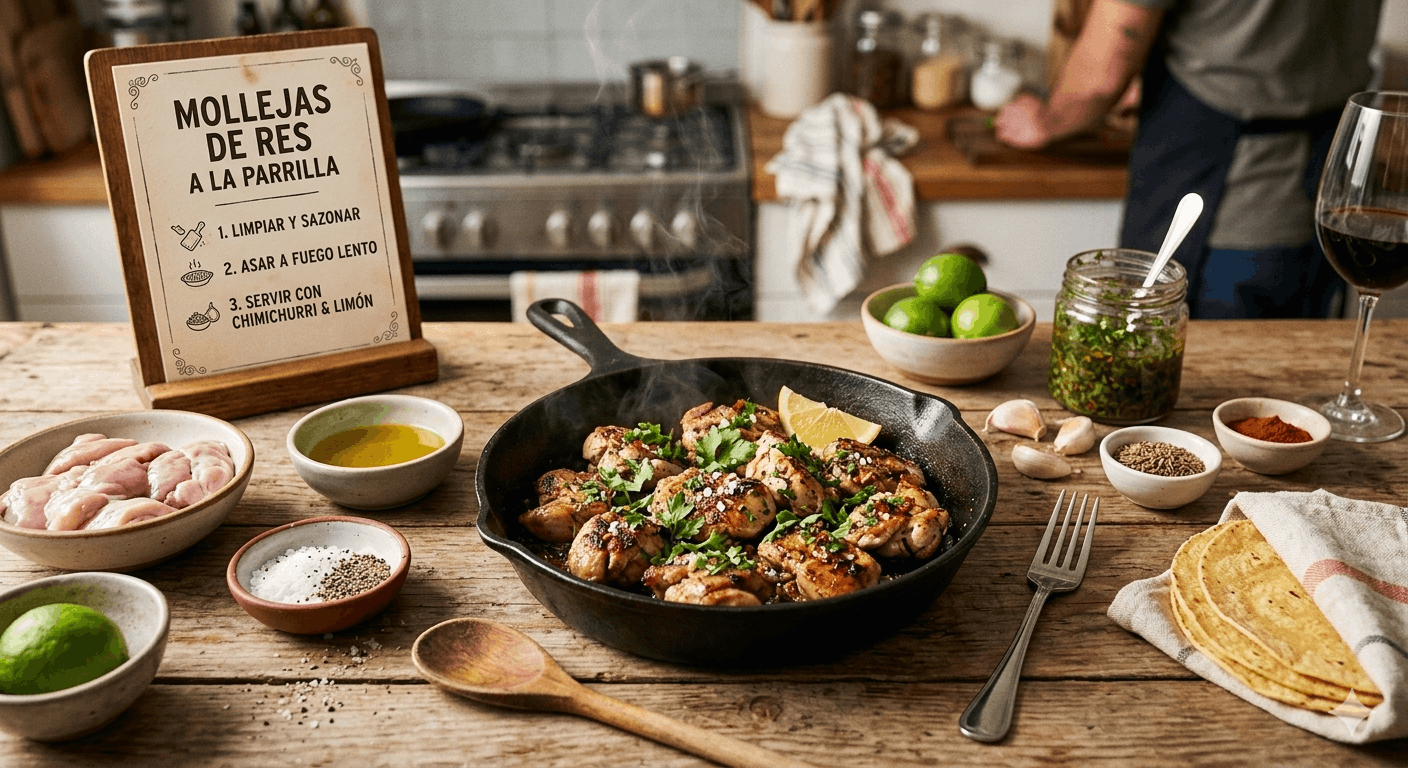

Mollejas De Res (Crispy Beef Sweetbreads)Recipe
Ingredients
Equipment
Method
- Step 1 — Soak to purify. Place the raw sweetbreads in a large bowl and cover completely with cold water. Add the tablespoon of white vinegar to the water, stir gently, and allow the sweetbreads to soak for a minimum of 1 hour — up to 2 hours for a noticeably cleaner, milder result. During this time the water will become tinged with a pale pink color as residual blood and impurities draw out. If the water turns deeply red, drain it, rinse the sweetbreads briefly under cold running water, and refill with fresh cold water to continue soaking. This soaking step is not optional — it is the single preparation step most responsible for the clean, mild, butter-like flavor that makes properly prepared sweetbreads so appealing. Sweetbreads that have not been soaked taste noticeably stronger and less refined.
- Step 2 — Parboil to firm and set the texture. Transfer the soaked sweetbreads to a medium saucepan and cover with fresh cold water. Add the teaspoon of salt. Bring to a gentle boil over medium heat, then reduce the heat to a low simmer and cook for 8 to 10 minutes. You are looking for the sweetbreads to turn from their raw, pale-beige translucent appearance to a fully opaque white, and to firm up slightly when pressed — they should feel like a dense, set custard rather than raw and yielding. Do not allow the water to boil aggressively, as vigorous boiling toughens the exterior. A gentle, barely moving simmer is what you want throughout.
- Step 3 — Shock, peel, and clean. The moment the sweetbreads are parboiled, remove them from the hot water and immediately transfer them to a bowl of cold water — add ice if available. The cold shock stops the cooking instantly and firms the outer membrane, making it much easier to peel. Allow them to sit in the cold water for 5 minutes. Then, working piece by piece over the cutting board, use your fingers and the tip of a sharp paring knife to peel away the thin, translucent outer membrane that covers each piece. It comes off in sheets and strips — work patiently and remove as much as possible. Also trim away any visible pieces of fat, gristle, or tough connective tissue (these appear as white, rubbery cords or fibrous sections). The interior should be smooth, soft, and uniform once cleaned.
- Step 4 — Cut into pieces and dry thoroughly. Cut the cleaned sweetbreads into bite-sized pieces — roughly 1 to 1½ inches. If any piece is particularly thick, slice it in half horizontally so all pieces cook evenly. Transfer the cut pieces to a plate lined with paper towels and press additional paper towels firmly on top. Pat them as dry as possible and allow them to air-dry for 5 additional minutes. This is critical: any surface moisture on the sweetbreads when they hit the hot pan will cause immediate steaming rather than searing, and steamed sweetbreads will never achieve the caramelized, crispy crust that defines a well-made molleja.
- Step 5 — Heat the pan and build the garlic basePlace your cast-iron skillet or heavy pan over medium-high heat and allow it to get fully, genuinely hot before adding any fat — this takes 2 to 3 minutes. Add the oil, lard, or butter and heat until it shimmers and moves easily across the pan surface. Reduce the heat slightly to medium and add the minced garlic, sautéing for about 30 seconds, just until it becomes fragrant and the raw garlic smell softens. Do not allow the garlic to brown at this stage — browned garlic before the meat goes in will turn bitter under the extended heat of the sweetbread cooking.
- Step 6 — Sear to a deep golden crustAdd the dried sweetbread pieces to the pan in a single layer — do not overcrowd. If your pan is not large enough to fit everything in a single layer with space between each piece, cook in two batches. Overcrowding causes the sweetbreads to steam rather than sear, and you will never develop the crust. Once in the pan, leave them completely undisturbed for 3 to 4 minutes — resist the urge to move them. This initial undisturbed contact with the hot surface is what builds the deep, caramelized, golden-brown crust that makes the dish. After 3 to 4 minutes, use tongs to turn each piece onto a new face. Continue cooking, turning occasionally, for a total of 10 to 15 minutes until all sides have developed an even, deep golden-brown crust that is crispy to the touch. The interior should still feel slightly yielding when you press a piece gently — if it feels completely firm throughout, it is approaching overcooked.
- Step 7 — Season and finish with citrus. Season the cooked sweetbreads with salt and freshly ground black pepper directly in the pan, tossing gently to coat. Remove the pan from the heat and squeeze the fresh lime or lemon juice over the entire batch. The citrus will sizzle and steam immediately against the hot pan — this is what you want. The acid cuts through the rich, buttery fat of the sweetbreads and lifts the whole dish into brightness. Serve immediately — mollejas are best within 5 minutes of finishing, while the crust is at its most crisp and the interior is still soft and warm.
- Step 8 — Assemble the tacos (if serving as tacos). Warm the corn tortillas two at a time directly over a gas flame or in a dry skillet until they are pliable, spotted with char in places, and fragrant. Double-stack them — two tortillas per taco. Spoon a generous portion of the hot sweetbreads into the center of each pair. Top with a small pile of finely diced white onion, a generous handful of chopped fresh cilantro, and a squeeze of lime. Add salsa to taste. Eat immediately — do not let the taco sit or the tortillas will soften and the sweetbread crust will lose its crispiness.
Video
Notes
- Soaking is the preparation step that separates good mollejas from great ones: A minimum of 1 hour in cold water with a splash of vinegar draws out the residual blood that gives unseasoned sweetbreads a stronger, more metallic flavor. If you have time for a 2-hour soak with one water change at the halfway mark, the result is noticeably cleaner and more delicate. Some traditional cooks soak overnight in the refrigerator for the mildest possible result.
- Dryness before frying is everything: Any surface moisture on the sweetbreads when they enter the hot pan immediately creates steam, which prevents the Maillard reaction (the chemical process that produces the golden-brown crust) from occurring. Pat them with paper towels, then allow them to air-dry for an additional 5 minutes. The dryer the surface, the more dramatic and even the crust.
- Cast-iron is the best pan for this recipe: The consistent, even heat retention of cast iron produces the most uniform browning across all faces of the sweetbreads. Stainless steel is a good second choice. Non-stick pans can work but produce a less developed crust because they cannot reach and maintain the same surface temperatures.
- How to know when they are perfectly cooked: The outside should be a deep, even golden-brown — darker than pale tan, lighter than burnt mahogany. When you press a piece gently with your fingertip, there should be slight give — the interior is still soft and warm. A completely firm piece is overcooked and the creamy interior will have dried out.
- Most common mistake — overcrowding the pan: If the pieces are touching each other, they trap steam and will steam rather than sear. The result is grey, soft, and unappetizing rather than golden and crispy. Cook in batches without any hesitation — the second batch is worth the wait.
- Variation — Argentine asado style: Instead of pan-frying, place the cleaned and dried (but not cut) sweetbreads directly on a charcoal or wood grill over medium heat. Cook low and slow for 20 to 30 minutes, turning occasionally, until the exterior is deeply charred and crispy on all sides and the interior is fully heated through. Season with nothing but coarse salt and serve with homemade chimichurri. This is the purist preparation and many consider it the finest way to eat mollejas.
- Variation — Butter-basted French style: Replace the oil with 3 tablespoons of unsalted butter. Once the sweetbreads are golden on the first side, tilt the pan and continuously baste them with the foaming butter using a spoon for the remainder of the cooking time. Finish with a squeeze of lemon, chopped fresh parsley, and serve with mashed potatoes. This is the classic French preparation (ris de veau) adapted for beef sweetbreads.
- Variation — Spiced Mexican street style: Add ½ teaspoon of ground cumin and a pinch of dried Mexican oregano to the pan along with the garlic. After the sweetbreads are cooked and plated, dust lightly with mild chili powder and finish with lime juice. This version leans into the taco-street-food identity and is outstanding with salsa verde.
- Sourcing tip: Beef sweetbreads are not typically stocked in mainstream supermarkets. Your best sources are: a Latin American butcher or carnicería (call ahead — they may need a day’s notice to set them aside), a halal butcher (which frequently stocks offal), or a full-service specialty butcher. Online butchers such as D’Artagnan also ship frozen sweetbreads nationally. Buy them fresh if possible and use within 1 day of purchase.
- Storage: Raw sweetbreads are highly perishable and should be cooked on the day of purchase, or within 24 hours maximum, stored in the coldest part of the refrigerator. Cooked sweetbreads can be stored in an airtight container in the refrigerator for up to 2 days. Reheat in a dry or lightly oiled skillet over medium heat to restore some of the exterior crispness — microwave reheating makes them rubbery.
- Freezing: Not recommended. Freezing and thawing significantly degrades the delicate texture of sweetbreads, producing a watery, mushy interior when cooked. Use fresh whenever possible.
- Scaling note: This recipe scales up linearly for a crowd. For 8 people, double all quantities and cook in batches — never double the quantity and try to cook it all at once, as the pan will be catastrophically overcrowded.
What are Mollejas De Res?
Table of Contents
The Ingredient at a Glance
Mollejas de res — literally “beef sweetbreads” in Spanish — are a type of offal (organ meat) taken from cattle. Specifically, they come from one of two glands in the animal: the thymus gland, located in the throat and chest (called mollejas de cogote or throat sweetbreads), or the pancreas, located in the abdomen (called mollejas de corazón or heart sweetbreads). Despite the confusing name, they contain no bread and have no particular sweetness — the English word “sweetbread” is thought to derive from the Old English swete (meaning “pleasant” or “delicious”) and brǣd (meaning “meat” or “flesh”), suggesting the name was always meant to convey palatability rather than flavor.
When raw, sweetbreads are soft, pale, and lobed — they look nothing like any familiar cut of meat. When cooked correctly through the three-stage process of soaking, parboiling, and high-heat searing, they are transformed into something entirely different: a golden, caramelized exterior shell that shatters at the bite, giving way to an interior that is soft and almost custardy, with a mild, rich, buttery flavor that is genuinely unlike anything else in the culinary repertoire. Their appeal lies in this extraordinary textural contrast, and in a flavor so delicate and clean that it absorbs seasoning beautifully without losing its own character.
The Two Types — Which One to Use
Throat sweetbreads (thymus gland) are the more commonly available and preferred type for home cooking. They have a softer, more delicate structure, are easier to clean (the membrane peels away more readily), and produce a more tender, creamy interior when cooked. Heart sweetbreads (pancreas) are slightly firmer, denser, and richer — some consider them to have a more complex flavor, but they are also more demanding to prepare and easier to overcook. For this recipe and for anyone approaching sweetbreads for the first time, throat sweetbreads are the recommended choice.
Mollejas Across Cultures
The preparation and cultural context of sweetbreads vary dramatically across the three cuisines that most prominently celebrate them. In Mexico, mollejas are a taquería staple — chopped into small pieces after the parboiling stage, crisped in a very hot griddle or pan, and served in doubled corn tortillas with onion, cilantro, lime, and salsa. The street taco application values maximum crust, speed of service, and the interplay between the rich sweetbreads and the acidic, fresh garnishes. In Argentina, mollejas are served at the asado — grilled slowly over glowing coals in whole or large pieces, seasoned only with coarse salt, and eaten alongside other cuts of the animal. The Argentine preparation emphasizes the sweetbreads’ natural richness and the char that comes from prolonged contact with heat. In France, sweetbreads (called ris de veau when from veal, ris de bœuf when from beef) are elevated into the heights of classical cuisine — pan-seared in clarified butter, served with cream sauces, morel mushrooms, and asparagus, presented with the precision and restraint that defines haute cuisine.
NUTRITION: Mollejas De Res Recipe
Calories: Approximately 250–300 kcal (per serving, based on 4 servings, without tortillas)
| Nutrient | Per Serving |
|---|---|
| Protein | 22g |
| Total Fat | 17g |
| Saturated Fat | 5g |
| Carbohydrates | 2g |
| Fibre | 0g |
| Sugar | 0g |
| Sodium | 380mg |
| Cholesterol | 290mg |
| Iron | ~10% DV |
| Vitamin B12 | ~120% DV |
| Zinc | ~30% DV |
Values are approximate and will vary based on the specific cooking fat used (lard vs olive oil), the size of the sweetbreads, and whether tortillas and garnishes are included. Sweetbreads are high in cholesterol due to their organ-meat nature and should be enjoyed in moderation.
BENEFITS of Mollejas De Res Recipe
1. The Nutritional Profile Is Exceptional for an Organ Meat
Beef sweetbreads are among the most nutritionally dense foods in the entire animal. A single serving provides approximately 22 grams of complete protein with all essential amino acids. They are an extraordinary source of Vitamin B12 — a single serving can provide 100–120% of the recommended daily intake, making them one of the most concentrated B12 sources in all of food. They also provide significant zinc (important for immune function, wound healing, and testosterone production), iron in its most bioavailable heme form, phosphorus (for bone health and energy metabolism), and copper. Sweetbreads are high in cholesterol due to their glandular nature, which means they are best enjoyed in moderation, and as part of a varied diet — but within that context, they offer a micronutrient density that few conventional protein sources can match.
2. The Flavor Is Accessible Even for First-Time Offal Eaters
Among organ meats, sweetbreads occupy a uniquely approachable position. Liver has a pronounced, iron-forward bitterness that many people find challenging. Kidney has a strong, ammonia-adjacent flavor that requires significant preparation to manage. Heart is chewy and robustly beefy. Sweetbreads have none of these characteristics — their flavor is genuinely mild, buttery, and subtle. People who believe they dislike organ meats routinely enjoy well-prepared sweetbreads because the eating experience has almost nothing in common with the stronger offal cuts they associate with the category. They are the ideal entry point for anyone curious about organ meat cookery.
3. They Are a Zero-Waste, Sustainable Protein Choice
At the scale of global food production, using every part of an animal — including the glands, organs, and less familiar cuts — represents a more sustainable approach to meat consumption than relying exclusively on muscle cuts. Mollejas are a byproduct of beef production that, if not consumed, is discarded or rendered. Choosing to cook sweetbreads at home is a small but genuine contribution to a whole-animal eating philosophy that reduces waste, honors the animal, and typically costs significantly less per pound than premium muscle cuts.
4. The Cooking Technique Is a Genuinely Transferable Skill
The three-stage preparation for mollejas — soaking, parboiling to firm, searing to crust — is a classical French technique applied to offal that appears in variations across many cuisines and many cuts. Mastering it with sweetbreads builds an understanding of how to handle delicate, protein-rich ingredients: how soaking removes off-flavors, how parboiling sets structure without fully cooking, how to recognize a properly cleaned membrane, and how to achieve maximum crust without overcooking. These skills transfer directly to the preparation of other offal cuts, to delicate seafood preparations, and to any recipe that requires building a sear on a high-moisture ingredient.
5. It Is Significantly Less Expensive Than Comparably Impressive Restaurant Dishes
In a restaurant context — particularly in a steakhouse or a fine-dining establishment — sweetbreads are invariably listed among the premium items on the menu, often priced at $22–$38 for a starter portion. The ingredient cost at the butcher level is a fraction of that: beef sweetbreads typically run $5–$12 per pound, depending on the supplier and region, meaning that a generous home-cooked portion for four people can be produced for less than the cost of a single restaurant serving. For anyone who enjoys restaurant sweetbreads but finds the price prohibitive, home preparation offers the same experience at a fundamentally different cost.
6. They represent a living connection to Traditional Food Culture
Cooking mollejas de res at home connects directly to the food traditions of multiple living cultures — Mexican taquería culture, Argentine asado tradition, and classical French cuisine. These are not historical curiosities but active, vibrant culinary practices that millions of people participate in daily. Making this dish at home participates in those traditions in a genuine, hands-on way.
BEST COMBINATIONS with Mollejas De Res Recipe
As Tacos — The Classic Mexican Presentation
The taco format is the most widely eaten and best-loved preparation for mollejas in home and street food contexts. The specifics of what accompanies them matter enormously:
- Corn tortillas — doubled, not flour: Small (4–5 inch) corn tortillas, doubled and warmed directly over a flame, provide the structural integrity and corn flavor that flour tortillas cannot. The slight char on a properly warmed corn tortilla adds a bitterness that counterpoints the rich sweetbread beautifully.
- White onion, finely diced: White onion’s sharp, clean pungency provides the primary flavor contrast to the mollejas. It should be diced very small — roughly ¼ inch —, so it distributes evenly without overpowering any single bite.
- Fresh cilantro in large quantities: Cilantro is not optional in a proper molleja taco. Its bright, herbal, slightly anise-like character is the flavor that defines Mexican street food, and that makes the taco taste cohesive rather than simply “meat in a shell.”
- Lime — squeezed at the table: The acid from fresh lime juice applied moments before eating is the finishing element that makes every other flavor more vivid. Use the lime generously.
- Salsa verde: Tomatillo-based green salsa is the most harmonious pairing for sweetbreads — its tanginess and mild heat complement rather than compete with the delicate, buttery flavor of the mollejas. A good chile de árbol salsa roja is also excellent for heat lovers.
Argentine-Style Side Dishes
For the asado presentation, the simplicity of the sweetbreads demands side dishes that are equally unfussy:
- Chimichurri: The definitive Argentine condiment — flat-leaf parsley, garlic, dried oregano, red wine vinegar, and olive oil. Its bright acidity and herbal freshness cut through the fat of the grilled sweetbreads in the same way that lime does in the taco context, but with more complexity and depth. Make it at least 30 minutes before serving so the flavors blend.
- Grilled vegetables: Halved bell peppers, thick-cut zucchini, and whole green onions placed directly on the grill alongside the sweetbreads. Their slight char and natural sweetness complement the mollejas without competing.
- Roasted potatoes with garlic: Sturdy, satisfying, and neutral — roasted potatoes provide the carbohydrate balance that the protein-rich sweetbreads need at a larger meal. Season simply with olive oil, coarse salt, and fresh rosemary.
- Crusty bread: At an Argentine asado, good crusty bread is always on the table. It serves as a vehicle for mopping up the garlic-infused oil from the pan or the chimichurri from the plate.
French-Style Accompaniments
For a more refined, restaurant-style presentation:
- Mashed potatoes (pommes purée): Rich, buttery, and smooth — the potato’s starchy creaminess mirrors the sweetbread’s interior texture and creates a cohesive mouthfeel. Season the mash more aggressively than you think necessary, as it will be served alongside a strongly flavored main.
- Sautéed morel mushrooms: Morel mushrooms have an earthy, nutty flavor with natural umami that pairs with sweetbreads the way it does with veal in classical French cuisine. Sauté them in butter with a little thyme and a splash of cream.
- Blanched asparagus with lemon butter: The grassy, vegetal character of asparagus with the sharpness of lemon butter is a classical French pairing for all sweetbreads preparations. The brightness cuts through the fat of both the sweetbreads and the morels.
- Dry white wine: A full-bodied, aged Burgundy white (Chardonnay) or a dry Alsatian Pinot Gris pairs beautifully with the butter-seared sweetbreads — the wine’s richness mirrors the ingredient, and its acidity provides balance.
Drink Pairings for All Styles
- Mexican lager (Modelo, Dos Equis, Pacifico): The clean, slightly bitter character of a cold Mexican lager is the natural drink alongside molleja tacos — it cuts through the fat, cleanses the palate, and does not compete with the lime and cilantro.
- Michelada: A beer-based drink with lime juice, hot sauce, and salt — essentially the same flavor notes as the taco garnishes in liquid form. A brilliant pairing.
- Malbec (Argentine): Argentine Malbec’s dark fruit, firm tannins, and earthy notes are a natural complement to grilled asado sweetbreads. The tannins cut through the fat, and the fruit notes echo the slight caramelization on the grill.
- Mezcal with a lime wedge: The smokiness of a good joven mezcal echoes the char on the grilled or pan-fried sweetbreads and adds a depth and complexity that makes every sip and every bite more interesting.
FAQs
Are mollejas safe to eat?
Yes — when purchased from a reputable butcher, properly soaked, fully parboiled, and cooked to an internal temperature that ensures they are heated throughout, beef sweetbreads are completely safe. They are widely consumed in multiple countries and across multiple food cultures without incident. As with any organ meat, freshness is the critical safety variable: buy them fresh, use them within 24 hours of purchase, and cook them thoroughly. Do not consume raw or undercooked sweetbreads.
Do mollejas taste like liver or kidney?
No, and this is the most important misconception to address for anyone hesitant to try them. Liver and kidney have pronounced, iron-forward, sometimes ammonia-adjacent flavors that many people find strong or challenging. Sweetbreads taste nothing like either. Their flavor is mild, buttery, slightly nutty, and clean — closer to a rich, delicate dairy product than to conventional organ meats. The reason is that the thymus and pancreas are glands rather than filtering organs, so they do not accumulate the concentrated compounds that give the liver and kidneys their characteristic intensity.
Where do I buy beef sweetbreads?
The most reliable sources are: a Latin American carnicería (butcher), which may need 24 hours’ notice to set them aside; a halal butcher, which frequently stocks offal; a full-service specialty butcher; or an online butcher (D’Artagnan ships frozen sweetbreads nationally in the US). They are rarely stocked in standard supermarkets. Calling ahead is strongly recommended — even butchers who regularly carry sweetbreads may sell out quickly.
Can I skip the parboiling step?
Not recommended. The parboiling step serves two essential purposes: it firms the sweetbreads to a density that allows them to be cleaned effectively (the membrane is very difficult to remove from raw sweetbreads), and it sets the internal structure so that the subsequent searing step can develop a crust on the exterior without needing to cook the interior at the same time. Sweetbreads that go directly from soaking to frying without parboiling often end up unevenly cooked — overcooked on the outside, gelatinous and undercooked on the inside.
How do I know when mollejas are overcooked?
Overcooked sweetbreads lose the creamy, soft interior that makes them special and become uniformly firm and dry throughout — the texture becomes dense and chewy rather than yielding and almost custardy. You can test during cooking by pressing a piece gently with your fingertip: it should have a slight give. If it feels firm throughout with no give at all, it has been cooked too long. The exterior color is also a guide — a deep, golden-brown crust is correct; a very dark mahogany or blackened surface indicates overcooking.
Can I grill mollejas instead of pan-frying them?
Absolutely — grilling is traditional and arguably the most rewarding method. After soaking and parboiling, pat the sweetbreads dry, season generously with coarse salt, and place them on a medium-heat charcoal or gas grill. Cook for 20 to 30 minutes total, turning every 5 to 7 minutes, until the exterior is deeply charred and crispy on all surfaces. The longer, lower-temperature cooking of the grill produces a different — but equally remarkable — result from the pan: a smokier, more rustic exterior with the same soft interior. This is the Argentine asado method, and it produces sweetbreads of exceptional quality.
Can I make this ahead of time?
The soaking and parboiling stages can be done up to 24 hours in advance. After parboiling, cool the sweetbreads completely, clean them, and store in an airtight container in the refrigerator. The final searing step must be done immediately before serving — sweetbreads lose their crust within minutes and do not reheat well to their original texture. For a dinner party, complete all prep work the day before, then sear for 10 to 15 minutes just before your guests sit down.
What is the difference between veal sweetbreads and beef sweetbreads?
Veal sweetbreads (from young calves) are more tender, more delicate in flavor, and generally more prized in classical French cuisine (where they are called ris de veau). They are also significantly more expensive and harder to find. Beef sweetbreads from adult cattle are slightly firmer, more robust in flavor, and far more accessible — particularly at Latin American butchers. For Mexican and Argentine preparations, beef sweetbreads are the traditional ingredient and produce results that are just as rewarding as veal in their own culinary context.
Can leftover mollejas be reheated?
They can be reheated in a dry cast-iron or stainless-steel pan over medium-high heat for 3 to 4 minutes per side, which will restore some of the exterior crispness. Microwave reheating makes them rubbery and should be avoided. The honestly best approach, if planning for leftovers, is to cook a slightly smaller batch and not attempt to carry the rest over — freshly cooked mollejas are dramatically superior to reheated ones.

Wonderful