
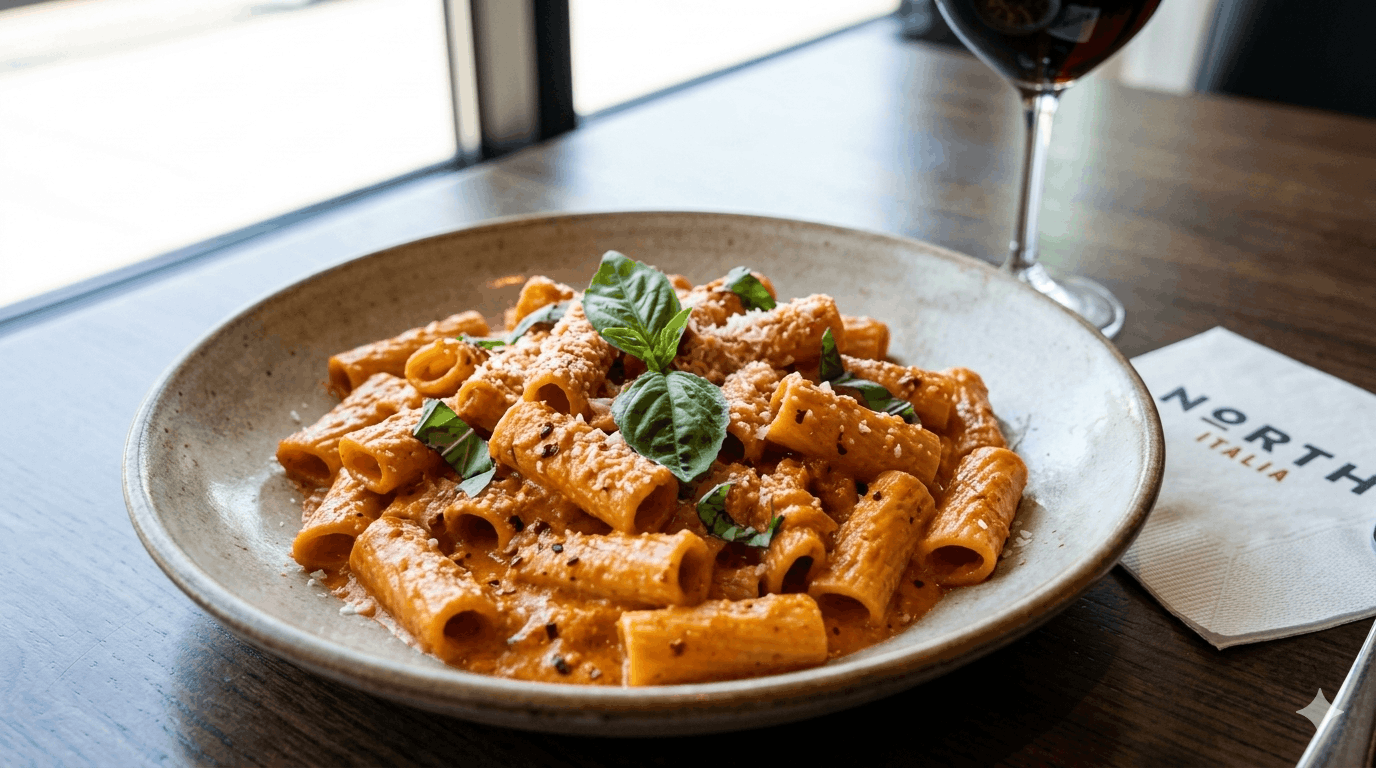
North Italia Spicy Rigatoni Vodka Recipe
Ingredients
Equipment
Method
- Step 1 — Boil pasta in aggressively salted water. Fill your large pot with cold water and set it over high heat. When it reaches a full rolling boil, add a generous amount of kosher salt — the water should taste pleasantly salty, not like the ocean, but unmistakably seasoned. This is one of the most important steps in the entire recipe: pasta cooked in well-salted water is seasoned from within and has a completely different, more developed flavor than pasta cooked in plain water. Add the 16 oz of rigatoni and cook according to the package instructions, checking for doneness about 1 to 2 minutes before the recommended time — you want al dente, meaning the pasta still has the faintest resistance when you bite through it, because it will finish cooking briefly in the hot sauce. Before draining, set a ladle or cup next to the pot now as a reminder — scoop out at least ¾ cup of the starchy pasta water and set it aside. Drain the rigatoni in a colander and toss lightly with a few drops of olive oil to prevent sticking while you finish the sauce.
- Step 2 — Soften the onion, shallots, and garlic slowlyWhile the pasta water heats, begin the sauce. Heat the olive oil in your large, deep skillet over medium heat. Add the diced yellow onion and shallots and immediately reduce the heat to medium-low. This slower cooking pace is important — you want the onion to soften completely and turn translucent and almost jammy, which takes 6 to 8 minutes, not the 2 to 3 minutes that a higher heat would suggest. Do not let them color or brown at this stage; the goal is sweetness through slow cooking, not caramelization. Stir frequently. When the onion is completely soft and translucent and you can see through it, add the minced garlic and stir for exactly 30 to 45 seconds — until you can smell it bloom fragrant and fresh. Pull the pan back from the heat immediately if the garlic starts to turn golden; burned garlic turns bitter and cannot be fixed.
- Step 3 — Cook down the tomato paste and chili pasteAdd the Calabrian chili paste and tomato paste directly to the softened onion base and stir vigorously to combine everything. Increase the heat back to medium. Cook this mixture for 2 full minutes, stirring constantly, pressing the paste against the bottom of the pan. The paste will begin to darken from bright red to a deeper brick-red color and will start to stick and sizzle slightly — this is the caramelization you want. This step is called "toasting" the tomato paste, and it transforms its flavor from raw and slightly sharp to deep, rounded, and intensely tomato. Do not skip or rush it; undercooked tomato paste is the most common reason homemade vodka sauce tastes flat and one-dimensional.
- Step 4 — Deglaze with vodka and release the fond. Pour the vodka directly into the hot pan. It will sizzle dramatically and steam. Use your wooden spoon to scrape up every brown, sticky bit from the bottom of the pan — this is the "fond," and it is concentrated flavor. Stir it into the liquid as it dissolves. Allow the vodka to cook for 2 to 3 minutes over medium heat, stirring occasionally, until the sharp alcohol smell has dissipated and the liquid has reduced slightly. You are not trying to eliminate all the vodka flavor — you are cooking off the harsh ethanol while preserving the flavor compounds that vodka uniquely extracts from tomato. The sauce at this stage should smell deeply of cooked tomato with a warm, spiced note from the Calabrian chili.
- Step 5 — Add cream and cheese, build the sauce. Reduce the heat to low. Pour in the heavy cream in a slow, steady stream, stirring as you pour to combine it smoothly with the tomato base. The sauce will turn from a deep red-orange to a beautiful coral-orange color as the cream integrates. Add the tablespoon of butter and stir gently until it melts into the sauce. Add the freshly grated Parmigiano Reggiano in two additions, stirring after each until fully melted and the sauce is completely smooth. Add ¼ cup of the reserved pasta water and stir — the sauce will loosen and take on a glossier sheen from the starch. Taste at this point: it should be rich, spicy, creamy, and deeply savory. Adjust with a pinch of salt if needed (the cheese is salty, so be conservative).
- Step 6 — Blend the sauce smooth (strongly recommended). This step is optional but is what produces the signature North Italia restaurant-level texture. Use your immersion blender to blend the sauce directly in the pan for 20 to 30 seconds until it is completely smooth and silky — no visible onion or chili fleck pieces. The transformation is immediate and dramatic: the sauce goes from textured and rustic to glossy and uniform in seconds. If using a countertop blender, carefully ladle the hot sauce in batches (never more than half-full), hold the lid down firmly with a folded kitchen towel, and blend until smooth. Return to the pan. This blending step is what separates a good homemade vodka sauce from a great one.
- Step 7 — Toss the pasta in the sauce and serve immediately. Add the drained rigatoni directly to the pan of sauce over low heat. Using tongs, toss the pasta with the sauce, turning it repeatedly for 1 to 2 minutes until every piece is thoroughly coated and the sauce has thickened slightly from contact with the hot pasta. If the sauce feels too thick, add pasta water one tablespoon at a time, tossing after each addition. The finished dish should look glossy and heavily sauced — every tube coated both inside and out with clinging orange-red cream. Serve immediately into warmed bowls. Finish each portion with a generous shower of freshly grated Parmigiano Reggiano, a few fresh basil leaves torn over the top, and if you are feeling particularly North Italia about it, a small pat of cold butter placed on top to melt at the table.
Video
Notes
- Calabrian chili paste is the key flavor differentiator: This is the ingredient that makes North Italia’s vodka sauce taste distinctly different from a standard penne alla vodka. Calabrian chilies (from Calabria in southern Italy) have a fruity, smoky, medium heat that is more complex and layered than red pepper flakes. Look for it in the Italian foods aisle, at Trader Joe’s (sold as “Italian Bomba Hot Pepper Sauce”), or online. If truly unavailable, use ½ teaspoon of red pepper flakes — the dish will still be good, but the flavor signature will be different.
- Toast the tomato paste — do not skip this: Two minutes of cooking the tomato paste against the hot pan before adding liquids caramelizes its natural sugars, deepens its color from bright red to brick-red, and transforms its flavor from raw and sharp to rich and rounded. This one step accounts for more flavor development than any other single action in the recipe.
- Blend the sauce for the restaurant texture: North Italia’s sauce is noticeably smoother than a home-style vodka sauce because it is blended before the pasta is added. The immersion blender takes 30 seconds and produces a glossy, completely uniform sauce that looks and feels luxurious. If you skip this step, the sauce will still taste excellent but will have visible onion and chili pieces throughout.
- Salt your pasta water properly: Use at least 1 tablespoon of kosher salt per quart of water — the water should taste seasoned. Under-salted pasta cooking water produces pasta that tastes flat, regardless of how good the sauce is.
- Reserve more pasta water than you think you need: ½ cup is the recipe minimum, but set aside ¾ to 1 cup. The starchy pasta water is the primary tool for adjusting sauce consistency at the end — it loosens and emulsifies the sauce without diluting flavor the way plain water would. Keep it warm in a small heatproof cup next to the stove.
- Variation — with guanciale or pancetta: Render 3–4 oz of diced guanciale or pancetta in the pan before adding the olive oil, removing the crisped meat and cooking the aromatics in the rendered fat. Fold the crispy meat back in at the end. This adds a porky, salty richness that many North Italia regulars specifically request.
- Variation — with Italian sausage: Crumble 8 oz of hot Italian sausage into the pan after the aromatics are softened and cook until fully browned before adding the chili paste and tomato paste. The spiced sausage amplifies the heat of the Calabrian chili and adds protein and texture.
- Variation — with burrata: At service, place a half ball of fresh burrata in the center of each bowl before tossing the hot pasta over it. The heat of the pasta melts the burrata’s outer shell and releases its creamy interior throughout the dish — an indulgent but extraordinary variation.
- Variation — heat level adjustment: The recipe as written is medium-heat. For mild: use ¼ teaspoon chili paste and remove all seeds if using whole chilies. For hot: increase to 1½ teaspoons chili paste and add a pinch of cayenne with the cream. For very hot: double the chili paste and finish each bowl with additional fresh Calabrian chili oil.
- Make-ahead: The sauce (through the blending step, before pasta is added) can be made up to 3 days ahead and refrigerated in an airtight container. Reheat gently over low heat, thinning with a splash of cream or pasta water as needed, before tossing with freshly cooked pasta. This is the ideal strategy for a dinner party — the sauce waiting on the stove, pasta boiled to order.
- Storage and reheating: Store leftover assembled pasta in an airtight container in the refrigerator for up to 3 days. To reheat: add 2 tablespoons of cream or milk per serving to a skillet over low heat, add the pasta, and stir gently until warmed through and the sauce has re-emulsified. The microwave works but produces a less smooth result — if using it, heat in 30-second intervals and stir between each.
- Freezing: The sauce alone freezes well for up to 2 months. The assembled pasta (sauce and rigatoni combined) does not freeze well — the pasta becomes mushy and the sauce breaks on thawing. Freeze only the sauce and cook fresh pasta when ready to serve.
- Scaling note: This recipe doubles cleanly for 8 servings. Use the same ratios and cook the sauce in a larger, wider pan to allow proper evaporation and caramelization. Do not reduce the cooking times proportionally — the onion and tomato paste still need the same amount of time regardless of quantity.
About North Italia Spicy Rigatoni Vodka
The Dish at a Glance
North Italia’s Spicy Rigatoni Vodka is a creamy tomato vodka pasta — a dish that belongs to the Italian-American genre of penne alla vodka but is elevated by two specific decisions that set it apart from every generic version of the category. The first is the use of Calabrian chili paste rather than red pepper flakes, which shifts the heat from a simple burn to a complex, fruity, smoky warmth with regional Italian character. The second is the blending of the sauce to a completely smooth, glossy, deeply orange-red consistency before the pasta is tossed in — a step that produces the restaurant’s signature visual and textural identity, where every tube of rigatoni is uniformly coated in a sauce that looks almost lacquered.
Table of Contents
The sauce is built on a long-cooked sweet onion and shallot base (which dissolves into the sauce during blending, providing sweetness and body without visible pieces), a carefully caramelized tomato paste for depth, a vodka deglaze for brightness and emulsification, and a generous finish of heavy cream, Parmigiano Reggiano, and butter for the richness that makes the dish genuinely satisfying. The rigatoni shape is chosen with intention — the ridged exterior grips the cream, and the hollow center captures sauce inside each tube, ensuring that every forkful delivers the maximum ratio of pasta to sauce.
About North Italia
North Italia is a modern Italian restaurant group founded in Scottsdale, Arizona, in 2013 by Fox Restaurant Concepts, the same group behind Flower Child and True Food Kitchen. The concept focuses on fresh, scratch-made Italian cooking with a California-influenced lightness — seasonal ingredients, hand-rolled pastas, and a menu that changes regularly with the seasons. The restaurant expanded rapidly across the Southwest and now operates locations across the United States. The Spicy Rigatoni Vodka has been one of its most consistently popular menu items since the restaurant’s early years, regularly cited in food media and social platforms as one of the must-order dishes at any North Italia location.
The Science of Why Vodka Belongs in This Sauce
Vodka’s role in pasta sauce is a chemistry story as much as a flavor one. Tomatoes contain flavor compounds that are fat-soluble (meaning they dissolve in oil or fat rather than water) and water-soluble. In a standard tomato cream sauce, the water-soluble compounds dissolve in the liquid base, and the fat-soluble compounds dissolve in the cream and olive oil. Alcohol — specifically ethanol — acts as a universal solvent that dissolves both types of compounds simultaneously, allowing them to coexist in the same sauce and producing a more complete, rounded tomato flavor than either water or fat alone. The ethanol itself cooks off almost entirely during the simmer, leaving behind only its flavor-extracting effect. This is why vodka pasta sauce tastes more intensely of tomato than a non-vodka cream sauce made with the same quantity of tomato paste.
NUTRITION
Calories: Approximately 640 kcal (per 1 serving, based on 4 servings)
| Nutrient | Per Serving |
|---|---|
| Protein | 20g |
| Total Fat | 32g |
| Saturated Fat | 16g |
| Carbohydrates | 68g |
| Fibre | 4g |
| Sugar | 7g |
| Sodium | 490mg |
| Cholesterol | 85mg |
Values are approximate and will vary based on the exact pasta brand, amount of cheese used, and whether additional butter or cheese is added at the table.
BENEFITS
1. Restaurant-Quality Flavor in 35 Minutes From Pantry Staples
The full flavor development of North Italia’s Spicy Rigatoni Vodka — caramelized aromatics, toasted tomato paste, vodka-extracted tomato compounds, cream-enriched sauce, Parmigiano finish — happens in under 40 minutes from first heat to first forkful. This places it squarely in the category of genuinely impressive weeknight cooking: a dish that looks and tastes like something from a good restaurant but requires no special technique, no unusual equipment beyond an immersion blender, and only ingredients that are available at any supermarket.
2. The Calabrian Chili Paste Provides Nutritionally Active Heat
Calabrian chilies, like all capsicum peppers, contain capsaicin — the compound responsible for their heat and for a range of studied health effects. Capsaicin has been associated in research with increased metabolic rate, anti-inflammatory properties, and the stimulation of endorphin release (which is part of why spicy food can produce a mood-elevating effect). The Calabrian paste in this recipe also provides Vitamin C, Vitamin A, and antioxidant carotenoids from the peppers themselves. This does not turn the dish into health food, but it means the heat element is doing more than just providing flavor.
3. It Is Genuinely Better the Day After — a Rare Quality in Pasta
Most cooked pasta dishes deteriorate overnight as the pasta absorbs the sauce and becomes either dry or mushy. Vodka sauce is an exception: the emulsified cream and fat base maintains its consistency overnight in the refrigerator, and the flavors — particularly the Calabrian chili, the Parmigiano, and the caramelized onion — continue to develop and deepen during refrigeration. A bowl of leftover Spicy Rigatoni Vodka reheated gently with a splash of cream is often indistinguishable from freshly made, and many regular cooks deliberately make a double batch for this reason.
4. The Sauce Can Be Made Entirely Ahead of Time for Effortless Entertaining
The sauce component (through the blending step) is fully make-ahead with zero quality compromise. This means that for a dinner party, the most labor-intensive part of the dish can be done 1 to 3 days in advance and refrigerated, leaving only the pasta cooking and the 2-minute tossing step for the day of. For a table of 8 to 10 people, this make-ahead quality makes the dish one of the most practical options in the repertoire — it looks impressive and tastes extraordinary, but demands almost no same-day effort.
5. It Teaches the Most Important Pasta Technique in Italian-American Cooking
The “finishing in the sauce” step — tossing the just-cooked pasta in the sauce over low heat for 1 to 2 minutes rather than simply pouring sauce over plated pasta — is the single technique that most distinguishes restaurant pasta from home-cooked pasta. During this brief toss, the pasta releases some of its surface starch into the sauce, the sauce reduces slightly and thickens around the pasta, and the two components become genuinely integrated rather than independent elements sharing a bowl. Mastering this technique in this recipe applies directly to every other pasta dish you will ever make.
6. The Dish Is Easily Adapted for Multiple Dietary Needs
Dairy-free: replace the heavy cream with full-fat canned coconut milk and the butter with a plant-based alternative; the Parmigiano can be omitted or replaced with a vegan hard cheese. Gluten-free: substitute a high-quality gluten-free rigatoni or penne (Jovial and Barilla both make good versions). Lower calorie: reduce the cream to ½ cup and the Parmigiano to ½ cup — the sauce will be thinner but still very flavorful. Protein-enhanced: add Italian sausage, grilled chicken, or sautéed shrimp. The recipe accommodates all of these adjustments without losing its essential character.
BEST COMBINATIONS
Sides That Balance the Richness
The Spicy Rigatoni Vodka is a rich, cream-based pasta that needs sides that provide contrast — acidity, freshness, and texture rather than additional richness.
- Arugula salad with lemon and Parmigiano: The most natural pairing. Arugula’s peppery bitterness and the sharp lemon dressing cut directly through the cream and reset the palate between bites. Dress it simply — lemon juice, good olive oil, salt, a shaving of Parmigiano — and serve it in a bowl alongside the pasta rather than mixed with it.
- Roasted broccolini or asparagus: Roasted at high heat until the tips char slightly, broccolini has a slightly bitter, nutty flavor that acts as a green vegetable counterpoint to the cream. Its slightly smoky char echoes the Calabrian chili’s smoky note harmoniously.
- Garlic bread or crusty sourdough: For soaking up the sauce that inevitably pools at the bottom of the bowl. This is both practical and deeply pleasurable. A garlic bread made with proper butter, fresh garlic, and a flash under the broiler is the ideal tool.
- Caesar salad: The anchovy-and-lemon-forward dressing of a properly made Caesar provides enough acidity and savory depth to stand up to the vodka sauce without being overwhelmed by it. A tableside Caesar is a particularly good match for an occasion when you are trying to replicate the full North Italia dining experience.
- Burrata with cherry tomatoes: A simple plate of fresh burrata drizzled with olive oil and scattered with halved cherry tomatoes and fresh basil, served before the pasta arrives, sets up the meal beautifully — the milky cream of the burrata foreshadows the cream in the sauce, and the tomatoes echo its tomato base.
Proteins to Add or Serve Alongside
- Guanciale or pancetta: Rendered until crispy and folded back into the finished pasta, the salty, porky fat of cured pork cheek elevates this dish toward something more complex and substantial while staying within the Italian tradition.
- Italian sausage: Hot Italian sausage crumbled and browned before the aromatics adds significant protein and amplifies the spice in a way that turns the dish into a more filling, one-bowl meal.
- Grilled chicken breast or thighs: Sliced and laid over the finished pasta, simple grilled chicken adds lean protein without competing with the sauce’s flavor.
- Sautéed shrimp: A classic addition that works particularly well — shrimp cooked quickly in butter and garlic, placed over the pasta at service, adds a sweet seafood note that contrasts beautifully with the tomato and Calabrian heat.
- Burrata at service: Half a ball of fresh burrata placed in the center of a bowl, then the hot pasta ladled around and slightly over it, creates a visual and textural moment when the burrata begins to melt — the cool, creamy interior contrasting with the hot, spicy pasta is extraordinary.
Wine Pairings
- Pinot Grigio (Italian): The definitive white wine pairing for this dish. Its clean acidity, mineral note, and relatively light body cut through the cream without competing with the Calabrian heat or the tomato. Santa Margherita, Jermann, and Livio Felluga are reliable producers.
- Dry Rosé (Provence or Italian): The acidity of a bone-dry rosé handles the cream in the same way as a white wine, while its slight red-fruit character adds a dimension that mirrors the Calabrian chili’s fruity quality. Particularly good in warmer weather.
- Chianti Classico: A medium-bodied Tuscan red made from Sangiovese grapes — its characteristic high acidity, firm tannins, and notes of cherry and leather make it one of the most food-friendly Italian red wines. The acidity cuts through the cream; the cherry fruit complements the tomato. A Chianti Classico Riserva would be outstanding.
- Barbera d’Asti: Often overlooked, Barbera has naturally high acidity and low tannins, making it an unusually versatile red for cream-based tomato pastas. Its dark fruit and slight earthiness complement the Calabrian chili without overwhelming the delicate cream.
- Sparkling water with lemon: For non-drinkers, the effervescence and lemon acidity of sparkling water with a squeeze of lemon provides the same palate-cleansing function as a dry wine between bites of the rich pasta.
Occasion Contexts
- Date night: The Spicy Rigatoni Vodka is the quintessential date-night pasta — impressive enough to signal effort, easy enough to execute without stress, and universally loved enough that you are unlikely to misjudge a partner’s preference. The blending step and the pasta-water emulsification give it a restaurant finish that communicates confidence in the kitchen.
- Casual dinner party for 4–8: Make a double batch of sauce up to 3 days ahead, refrigerate, then boil pasta in two batches and serve within 10 minutes of the first guests sitting down. The entire service is effortless, and the result is consistently spectacular.
- Weeknight dinner: At 35 minutes start to finish, this is genuine weeknight-friendly cooking that tastes like the weekend. Keep Calabrian chili paste, a tube of good tomato paste, and dried rigatoni in the pantry permanently, and this dish is always 35 minutes away.
Read More:
FAQs
Q: Can I make this without vodka?
Yes — the dish will be good, not quite the same. Vodka’s primary function is to extract and unify fat-soluble and water-soluble tomato flavor compounds that cannot be fully dissolved by cream or water alone. Without it, the sauce tastes slightly flat and less bright. The best alcohol-free substitute is a tablespoon of tomato paste added in addition to the recipe amount (for depth), plus 2 tablespoons of chicken or vegetable broth to deglaze the pan instead of the vodka. Some cooks also add a small splash of white wine vinegar at the end to replicate the brightness.
Q: Where do I find Calabrian chili paste?
Check the Italian foods aisle of your supermarket — it is increasingly common in most grocery stores. Trader Joe’s sells it as “Italian Bomba Hot Pepper Sauce,” which is essentially the same product. Whole Foods, Wegmans, and most specialty food stores stock it. If completely unavailable, the most workable substitute is ½ teaspoon of red pepper flakes, though the flavor difference will be noticeable — Calabrian paste has a fruity, smoky complexity that flakes do not.
Q: Why did my sauce break (separate into oily and watery parts)?
Sauce breaking (the fat separating from the water-based elements) is almost always caused by one of three things: adding the cream to a pan that is too hot (always reduce heat to low before the cream goes in), adding the Parmigiano too quickly (add in two small additions, stirring completely between each), or boiling the sauce after the cream and cheese are in (never let the sauce boil once cream is added — a gentle simmer is the maximum). To rescue a broken sauce: remove from heat, add a tablespoon of pasta water, and either whisk vigorously or use the immersion blender to re-emulsify.
Q: Can I use a different pasta shape?
Rigatoni is strongly preferred, but penne (also ridged and tubular), mezzi rigatoni (smaller rigatoni), shells (conchiglie), or orecchiette all work very well because their shapes trap and hold the thick sauce. Farfalle (bow ties) and fusilli (spirals) are adequate. Long pasta shapes — spaghetti, linguine, fettuccine — are not well-suited to this sauce because the thick, heavy cream does not cling to smooth, long strands the way it clings to ridged short shapes.
Q: How spicy is this dish?
As written, with ¾ teaspoon of Calabrian chili paste, the heat level is medium — most people would describe it as pleasantly warm, present, and building rather than sharp or painful. Children and very heat-sensitive adults should reduce it to ¼ teaspoon or omit. For enthusiasts of heat, ½ tablespoon to 1 tablespoon of chili paste produces a significantly spicier result. The cream does a notable job of cushioning the heat, so the perceived spiciness is always softer than the same quantity of chili would produce in a non-cream sauce.
Q: Can I make this vegetarian?
The base recipe is already vegetarian as written — no meat is included in any of the core ingredients. Use a high-quality vegetarian Parmigiano Reggiano (look for one that explicitly states it is made without animal rennet) or substitute Pecorino Romano, which is traditionally made with animal rennet but has vegetarian alternatives available. The dish is also naturally gluten-free if made with gluten-free pasta.
Q: How do I reheat leftovers without the sauce breaking?
Always add liquid when reheating — 2 tablespoons of cream or whole milk per serving is ideal. Heat in a skillet over medium-low heat, stirring gently and adding liquid as needed to bring the sauce back to its original consistency. Do not heat on high, which causes the fat to separate. If microwaving, add the liquid, heat in 30-second intervals, and stir between each interval. A splash of pasta water (kept from the original cooking) also works beautifully for reheating.
Q: Can I make the sauce dairy-free?
Yes — replace the heavy cream with full-fat canned coconut milk (not coconut cream beverage; the canned variety with high fat content), the butter with a plant-based block butter or refined coconut oil, and the Parmigiano with 3 tablespoons of nutritional yeast plus 1 tablespoon of white miso paste for a savory, umami-rich cheese substitute. The result is noticeably different from the dairy version but genuinely delicious in its own right — the coconut milk does not produce a tropical flavor in this context because the tomato, chili, and garlic are assertive enough to dominate.